Conflicts in her home country motivated Omnia's study choice – the Anne van den Ban Fund made it possible
- Omnia
- Master's student Governance of Sustainability Transformations

Art van Grondelle
“Coming here is one of the best decisions I've made in my life.”
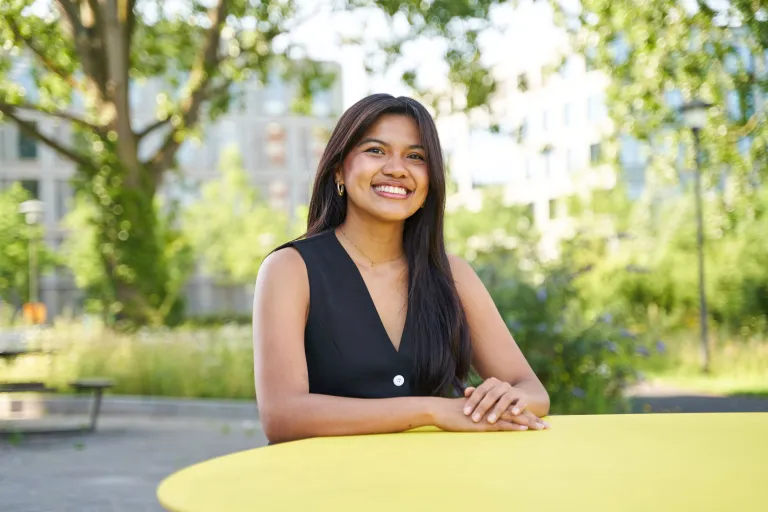
Omnia (23) is from Sudan, a country faced with many conflicts. The origins of these conflicts drove Omnia's choice to study Governance of Sustainability Transformations. Thanks to the Anne van den Ban scholarship she was able to continue her studies and pursue a master's degree in Wageningen.
Sudan is a country full of multitudes, according to the Wageningen student. “Sudan is part of East Africa and North Africa, and an unofficial member of the Middle East. It's part of the Islamic world, the Arab world, the African Union.” Before the colonial borders, the area consisted of small kingdoms and a federal political system. Maybe a more suitable system, argues Omnia. “We have had so many wars, because one government cannot potentially represent everybody. We are so diverse, and we share so many tribes with other bordering countries.”
The country is currently going through the biggest humanitarian crisis in the world. Wars have been waged in the country for decades, with the crisis in Darfur between 2003 and 2005 being one of its blackest times. Since 2023, a Sudanese civil war is being fought out between Sudanese government and the UAE-backed Rapid Support Forces, or RSF-militia. Though originally a civil war, the international stakes are high. Port Sudan is one of the biggest ports on the Red Sea, providing a strategic location for control over international shipping. The war forced Omnia and her family to flee, first going to and from a decreasing number of safe areas in the country, and then towards Egypt.
Turning conflict into a drive for change
The origins of the conflicts in Sudan motivated Omnia’s choice for Governance of Sustainability Transformations, the master’s programme she is currently enrolled in at Wageningen University. “I am most interested in the nexus between conflict and sustainable resource use. I believe that what started most of the civil wars, at least in Western Sudan, is climate change and mismanagement of resources. The Sahara started expanding in Sudanese territory because of the desertification, which affected the communities there. The people that are herding started going into the farmers' land because there was no other land to graze the animals. And then people start to fight.”
Omnia can pursue her master’s degree on this topic thanks to a scholarship of the Anne van den Ban Fund, giving her the opportunity to gain high-level education in a safe place. Without the scholarship, Omnia would have waited out the end of the war in Egypt, the tuition of Wageningen simply unattainable. “I don't even know if I would ever make that much money in Sudan in my lifetime.”

Art van Grondelle
Dreams for the future
The war also changed her career goals: “I have a bachelor’s in International Relations and Diplomatic Studies. I always wanted to be a diplomat or an ambassador, but that has become impossible due to the war.” Omnia now has a new dream job in mind: “Before I came to Wageningen, I was a teaching assistant in my university and I really loved it. So, I think my dream job would be a researcher and educator.” She also hopes to continue with her activism, sharing updates on the Sudanese war and advocating for her people online, for which she has gained a lot of international attention. When the war ends, Omnia considers combining her background in resource use with diplomacy. “Or I want to work in a large research organisation focused on sustainability and peace in the MENA-region.”
After she graduates, Omnia hopes to find a PhD-position. She is now part of the WASS-orientation graduate programme, a selective PhD-preparatory programme in Wageningen for social sciences. “I would like to design sustainability frameworks for fragile states. The current sustainability frameworks are mostly focused on neoliberal democratic states and do not work in states like Sudan.”
Lifeline in a dark time
Besides hard work, there is also time for social connections. “Wageningen is a very diverse place, and people have similar ideas that align with mine. I really found my place here. Though I'm not going to lie, life has been difficult at times. It is a struggle to see the place that you love so much being destroyed, and with both my parents still living there. But coming here is one of the best decisions I've made in my life.”
Though she is afraid to sound cliché, she does want to impress upon the donors: “You really are changing lives. Your donations are a lifeline in a dark time for students like me and I'm really grateful for it. I hope that when I grow old, I will be able to do the same thing for other younger students.”
Anne van den Ban Fund
The Anne van den Ban Fund provides scholarships for promising students from low-income countries to follow a master's at Wageningen University & Research. After their graduation, they return to their home country and contribute to solving pressing societal issues.
Questions?
Do you have a question about the Anne van den Ban Fund? Contact us.
Student stories
Read the stories of students who received support through University Fund Wageningen.

Support Talent
With your contribution, you support various activities and scholarships that help students and young researchers develop and get a flying start or leap in their careers.
Follow University Fund Wageningen on social media
Stay up-to-date and learn more through our social channels.