Wageningen Climate Hub: working together towards a climate-resilient region

The effects of climate change are becoming increasingly visible and noticeable. Hot, dry summers, heavy rainfall, wildfires and increasing pressure on the natural environment also pose major challenges for our own region. But how do you translate such a vast and complex issue into concrete solutions for the region? And how do you ensure that scientific knowledge is actually put to use in policy and practice? Through the Wageningen Climate Hub, Wageningen University & Research (WUR) aims to pool knowledge and resources in the Gelderse Vallei, the Veluwe and the surrounding areas, in order to work together on solutions to local climate issues.
“A great deal is already happening in the Gelderse Vallei region, the Veluwe and the surrounding areas, but all these people, expertise and initiatives are still far from always finding each other,” says Marlies van Ree, a researcher specialising in climate change and nature-based solutions at WUR and one of the driving forces behind the Wageningen Climate Hub. The hub is an initiative of the Dutch Climate Research Initiative (KIN), which brings science and practice closer together. To strengthen regional cooperation, KIN is funding a feasibility study into five so-called Climate Hubs: in Zeeland, Amsterdam, Twente, Nijmegen and, of course, Wageningen.
Pooling regional resources
WUR has been conducting research into climate change and its consequences for many years. Researchers at Wageningen contribute to the IPCC’s international climate reports. They are also working on visions for the future such as NL2120, which explores how the Netherlands can adapt to a changing climate in the long term. “Climate change is a global problem, but all the necessary actions come together in the region,” says Tim van Hattum, Climate Programme Manager at WUR. “Working on solutions starts in our own back garden.” Within that region too, WUR works with a wide range of partners, but often on an ad hoc basis rather than through long-term collaborations. Through the Climate Hub, WUR aims to strengthen regional cooperation and make better use of existing knowledge.
Sharing and gathering knowledge
“The biggest challenge is not so much that we need more knowledge, but how we can apply the knowledge we already have and link up existing initiatives,” says Marlies van Ree. It is not just about imparting knowledge, but also about gathering it. “There’s quite a gap between what we do and what actually happens in practice,” adds Tim van Hattum. “We still don’t have a clear enough picture of how things work in practice. The region is an ideal testing ground for this, where we can work together to develop solutions that can also be applied elsewhere.”
Climate change back on the agenda
“Leadership commitment”: leaders who prioritise climate action are a key focus for the Climate Hubs. Whilst the consequences of climate change are becoming increasingly apparent, the issue risks being overshadowed by other social issues such as migration, the housing crisis and the energy transition. “We want to put climate change back at the top of the regional agenda because we can see that all the major issues we face are linked to the climate,” says van Ree. “You don’t solve them in isolation, but only in context. In practice, that still happens very rarely because it is so complex."
From knowledge to action: events and contacts
Tim van Hattum hopes that, in five to ten years’ time, the gap between research, policy and practice will have narrowed significantly thanks to the Climate Hubs, “and that we will actually put into practice everything we’ve been talking about for so long.” Examples include making cities greener, managing local forests differently and developing nature-based solutions in areas such as floodplains. “We need to translate our visions for the future into concrete short-term actions; only then can we, as a region, truly be a source of inspiration for others,” adds van Ree.
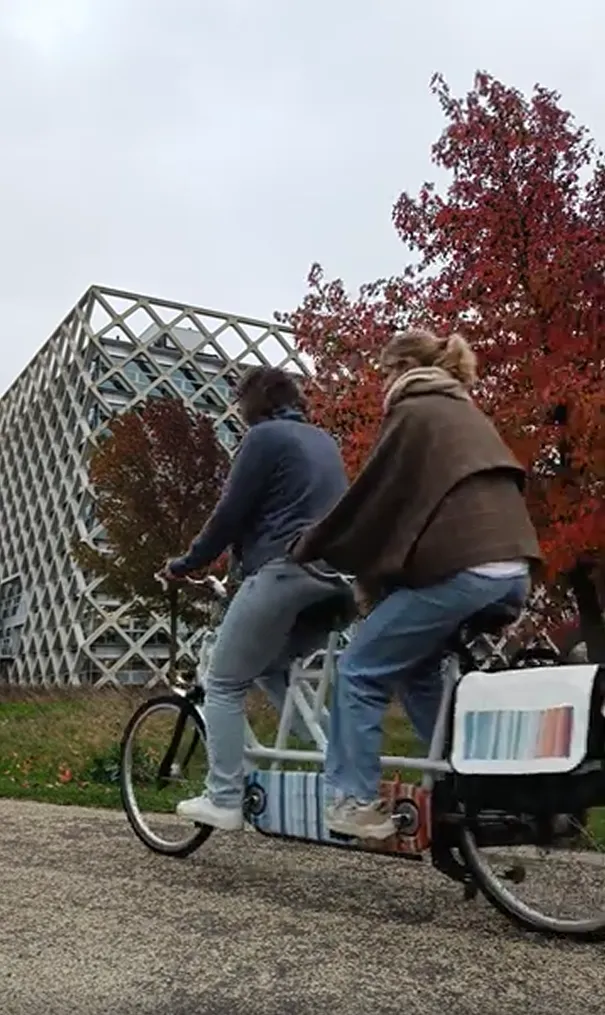
To take the next steps, the Wageningen Climate Hub regularly brings people and organisations together. For example, researchers, administrators and regional partners will come together in Wageningen on 2 November, during National Climate Week, to exchange knowledge and explore new opportunities for collaboration. The hub is also exploring creative ways to bring people together, for example through the 'Op de klimaattandem met…' initiative. During these tandem bike rides, WUR researchers and regional partners will discuss climate issues and possible solutions.
Op de klimaattandem met...
During tandem bike rides, WUR researchers and regional partners engage in conversations about climate challenges and potential solutions. Curious about our 'KlimaatTandem'? Watch the video!
Four questions about the Wageningen Climate Hub
The Wageningen Climate Hub is a regional network in which researchers, policymakers and stakeholders involved in implementation work together to find solutions to climate issues. The hub focuses on the Gelderse Vallei, the Veluwe and the surrounding areas. The boundaries are not strictly defined: it is more important to identify where issues arise and where there are opportunities to bring together knowledge, policy and practice, and to work together on solutions.
The hub is part of a national initiative run by the Dutch Climate Research Initiative (KIN), which is affiliated with NWO. Five research institutions are exploring ways to strengthen regional cooperation on climate change. In doing so, they share knowledge and experiences and develop new ways of working together. For Wageningen, this presents an opportunity to make better use of scientific knowledge within its own community. WUR combines fundamental and applied research with expertise in the fields of agriculture, food, water, nature, biodiversity and social change. The Climate Hub builds on existing networks and initiatives, such as Regio Foodvalley and Vallei & Veluwe Klimaatbestendig.
The hub is still very much under development. Through discussions and meetings with regional partners, we are exploring what the needs are, how collaboration might take shape, and where WUR can add value. This is not just about exchanging knowledge, but also about learning together, experimenting and developing new forms of collaboration.
The Gelderse Vallei, the Veluwe and the surrounding areas face major challenges. Climate change is leading to longer dry spells, heavier downpours and higher temperatures. The region also faces other challenges, such as nature restoration, making agriculture more sustainable, the energy transition and housing construction. These issues are closely interlinked and require a joint approach.
Water: from drought to flooding
The Veluwe is one of the Netherlands’ most important groundwater reservoirs. Rainwater seeps deep into the ground and feeds the streams and groundwater in the surrounding valleys. Increasing drought is putting pressure on the availability of water for nature, agriculture and drinking water supplies. At the same time, the region must prepare for periods of heavy rainfall.
Nature and agriculture under pressure
The Veluwe is affected by major issues relating to drought, nitrogen and the loss of biodiversity. In the Gelderse Vallei, the agricultural sector is facing a radical transition. Both areas have their own characteristics, challenges and opportunities. What forms of agriculture are suited to the landscape and the climate of the future? How can we ensure healthy soils, sufficient water and a liveable countryside? And how can agriculture and nature reinforce each other? By investigating which forms of nature-inclusive agriculture are best suited to different areas, such as the Veluwe and the Gelderse Vallei, opportunities arise to enhance biodiversity, improve water management and make the landscape more resilient to climate change.
Space for housing, energy and nature
The demand for housing and sustainable energy is growing, whilst nature, agriculture and water also require space. We can’t do everything everywhere. Where can we build sustainably? How do we integrate sustainable energy solutions into the landscape? How can we reduce the pressure on the natural world and create more space for nature in a changing climate? It is important to ensure that the choices we make today do not lead to new problems for the region in the future.
Read the full vision for the future, Een watergestuurde regio – Vallei en Veluwe in 2120 [A Water-Driven Region – The Vallei and the Veluwe in 2120], developed by WUR in collaboration with regional partners
Anyone who wants to help make our region climate-resilient – from researchers and policymakers to entrepreneurs, civil society organisations and engaged members of the public. For regional authorities and administrators, the hub provides access to scientific knowledge and a network of experts and partners from the field. This enables them to make well-informed decisions on matters such as water management, spatial planning, agriculture and the natural environment.
For researchers, the hub offers opportunities to apply knowledge in practice and to develop new research questions in collaboration with regional partners. “At WUR, we want to be not just a centre of excellence, but also a partner that helps tackle the major challenges facing our region,” says Marlies van Ree. “There are a great many motivated people working on these issues in this region. The challenge is to bring them together and get them moving forward as a group."
The Wageningen Climate Hub is still under development and is open to new ideas, initiatives and partnerships. Over the coming period, WUR will be working with partners from the region to identify where the greatest needs lie. This is achieved, amongst other things, through discussions, joint meetings and workshops. So this is the perfect time to get involved in the initiative!
Taking action together
Do you have a climate-related challenge, a great idea or an initiative you'd like to take further? Get in touch with us!


