Roadworks, construction and even aerospace can improve in sustainability thanks to lignin
- Richard Gosselink
- Project leader WUR

“Biobased asphalt, in which lignin replaces half of the fossil bitumen, has a 30% lower CO2 emission. If we can achieve 100% replacement, this will double.”
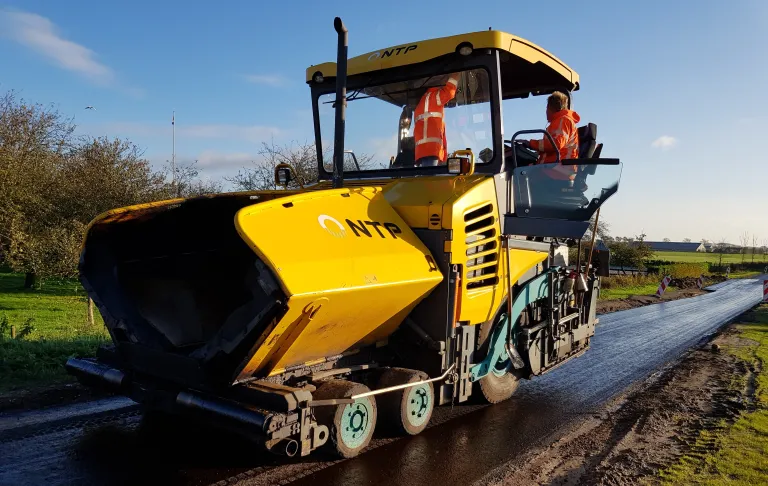
Across The Netherlands, dozens of road sections already contain a naturally derived ingredient in their asphalt: lignin. Wageningen University & Research (WUR) has transformed this plant-based component into a more environmentally friendly binder. Following its successful application in road surfaces, researchers are now developing lignin-based binders for use in the construction sector and even in aviation.
The Netherlands produces 10 million tons of asphalt annually, which roughly consists of gravel, sand, and the binder bitumen. Bitumen is produced in the petroleum industry, where it remains after the extraction of gasoline and various other substances. This leads to significant CO2 emissions. "On a global scale, which amounts to 90 million tons of bitumen per year, a biobased alternative to bitumen could save up to approximately 100,000 tons of CO2 per year," says project leader Richard Gosselink of WUR.
Gosselink and other Wageningen researchers therefore set out to find a sustainable alternative to bitumen. This alternative had to be a natural resource that is readily available and functions well as an asphalt binder. "We deployed broad expertise to achieve this: knowledge of these types of natural resources, processing methods such as fractionation, the structure and function of materials at the smallest level, and scaling up production. We then also conducted economic analyses and life cycle assessments for the environmental impact."
This led the researchers to lignin, a protein that gives plant cells their rigidity. Lignin is currently a residual stream, created in the production of paper and cardboard, for example. This natural adhesive provides asphalt with the same structure and hold as bitumen and can be produced in large quantities. Companies in the pulp and paper industry often still use lignin at a low-grade, as a fuel for energy generation. "The willingness to invest in other lignin applications will increase when a stable sales market develops," says Gosselink. "Asphalt offers promising opportunities for this because the required volumes are large. Lignin's price is also approaching that of bitumen."
Before asphalt manufacturers switch, practical experience must first demonstrate whether the performance, lifespan, and risks of damage are sufficient. Therefore, more than 25 test roads across the Netherlands now feature lignin in the top layer, from a cycle path near the Wageningen campus to a provincial road in Groningen. The roads are constructed by construction partners, and core samples are regularly taken to measure the asphalt's performance and durability. These tests consistently yield positive results: the roads are in excellent condition and meet all specifications.
New calculations show that biobased asphalt in which half of the fossil bitumen is replaced by lignin leads to a 30% reduction in CO2 emissions. "If we succeed in replacing 100% of the bitumen, this percentage is expected to double to 60%," says Gosselink.
Moreover, the potential of lignin extends beyond asphalt, as shown by new projects initiated by the researchers. In collaboration with the Dutch company Trespa, WUR is developing panels for interior use in which half of the toxic substance phenol is replaced by lignin. According to Trespa's calculations, this already results in a 30 to 50% reduction in CO2 emissions.
Lignin's protective properties may also be useful in the future. Lignin naturally plays a role in stabilizing UV radiation. Gosselink: "We use this property in cosmetics and personal care products. Color is a key factor for such applications. That's why we've developed technology to produce light-colored lignin." And we also make building materials, such as window frames, that are more resistant to weather influences.' The first tests have also been conducted to use lignin as a component in aircraft fuel.
Delivered impact
WUR converts lignin residual streams into fully-fledged, biobased alternatives to bitumen and phenol, proven in more than 25 test roads and panel applications. With materials expertise, scaling up, and Life Cycle Analysis, WUR reduces CO2 emissions and decreases fossil dependency. The research also helps companies safely comply with legislation and unlock new circular markets.
Do you have a question?
Reach out to Richard Gosselink for more information:
Discover more


Explore more
Wageningen University & Research (WUR) is working on major global challenges related to food, biodiversity, and climate. Our knowledge is applied by our partners. In in-depth impact stories, we share more about our research and the impact we achieve.

Follow Food & Biobased Research on social media
Stay up-to-date and learn more about our research through our LinkedIn