PhD: Future visioning for the design of a robust water system in the Netherlands
Career at WUR
About us- Plenty of variety and challenges
- Pleasant working atmosphere
- Time for personal development
- Proper work-life balance
- Internationally leading
Your job
Are you interested in the robust supply of water for society? Do you sometimes wonder whether our current institutions and policies are good enough to withstand the challenges of climate change? Would you like to engage with societal stakeholders and work with them to develop a vision for the water system of the future and study what these stakeholders learn from the process? Then please apply to the position of PhD student ‘Future visioning for the design and governance of a robust future water system in the Netherlands’ at Wageningen University.
The Mission
Freshwater is becoming scarcer in the Netherlands, even as society demands cleaner surface water, safer drinking water, and a shift toward circular, climate-neutral systems. Reusing wastewater might offer a promising response, but there are also consequences to this way of meeting our water demands. Choices made now about how, where, and for whom wastewater is treated and reused will shape water systems, infrastructures, and institutional arrangements for decades to come. Yet those futures are far from settled. They depend on questions and require debate about topics like: Who should bear the cost of removing contaminants ‘forever chemicals’ also known as PFAS? What counts as an acceptable risk if it is too costly to remove all pollutants, and who gets to decide the standards for that? Which actors carry out which duties, and how do existing and incoming institutions shape what is possible?
This PhD-project is part of BlueVantage, an interdisciplinary research programme funded by the Dutch National Science Foundation (NWO). BlueVantage focuses on one of the defining challenges of the coming decades: how to ensure healthy, sustainable water provision as freshwater grows scarcer and pollution pressures intensify. This PhD project is one of several within the programme, offering the selected candidate a chance to work alongside researchers from across disciplines.
You will be supervised by Prof. Dave Huitema and Dr. Kirsty Holstead.
Your PhD: Designing and Governing circular water futures
You will implement the four-year PhD project - Future visions for design and governance of a robust circular water system in the Netherlands. Existing infrastructures, regulations, economic models, and institutional habits can lock in certain trajectories while locking out alternatives, meaning ‘futures thinking’ can reproduce the present. Your work will ask how we can open genuinely different possibilities for circular water, and to engage in debate with stakeholders about the pathways that could lead to their realisation.
You will examine three guiding question areas:
- What does the current water provision system in the Netherlands look like, which institutions and policies control it, on which principles is it based, and what is the appetite for change to incorporate new concepts such as water reuse, advanced water purification and circularity?
- Which challenges can be foreseen, and what alternative futures can be imagined addressing these challenges, and how desirable are these? How do concerns about water quality, including emerging contaminants like PFAS, and the views of innovative technological or governance solutions shape or constrain those visions?
- Where do the stakeholder's visions align and where do they collide, and is it possible to come to agreement on the principles and norms that should underpin a desirable vision for the future water provision system? Do positions shift through deliberation? When regional actors come together to discuss circular water, how do their views change, where do contestations remain, and what do those tell us about the deeper governance challenges of circular water transitions?
You will engage with academic debates on deliberative governance, policy-oriented learning, and the role of lock-ins in sustainability transformations, while remaining anchored in the practical challenges of BlueVantage.
Approach and Methods
The project takes a dialogue heavy, participatory, and future-oriented approach. You will work directly with actors across the Dutch water system, including water authorities, drinking water companies, industry, regulators, NGOs, and civil society organisations to surface, contest, and develop visions for circular water.
The core methods for vision building are scenario and backcasting workshops, deliberative sessions, and where appropriate, serious gaming and structured feedback loops. The extent to which stakeholders learn from dialogues is assessed through structured interviews, observational techniques, causal loop diagrams, and concept maps. Together, these are designed to map futures, expose the assumptions, uncertainties, and disagreements; and to potentially loosen lock-ins which affect possible alternative futures.
Through this work, you will identify the system-level choices that will define alternative robust water futures in the Netherlands. These include governance models (centralised vs decentralised), the norms of guiding decisions (health protection, ecological integrity, economic value), regulatory and innovation frameworks, and the allocation of risks, costs, and responsibilities. A recurring thread will be how to handle emerging contaminants such as PFAS, for which the question is - where in the water cycle treatment can be most effective and most equitable.
The aim is to translate scenarios, system level choices, and relevant principles into transition pathways that can inform decision-making at local and regional levels. The research must contribute to both academic debate and practice.
Your duties and responsibilities include:
As part of this PhD, you will work with an interdisciplinary team to identify and analyse futures of wastewater in the Netherlands. Your research will focus on:
- Publishing a PhD thesis based on three to four articles connected to the project work.
- Performing duties under the Blue Vantage project, including participation in the general project activities, the production of deliverables and organisational work (meetings, reports, workshops, other events).
- Teaching (10% of time) in the form of contributions to the group's courses in the various teaching programs of the WUR and thesis supervision of BSc and MSc students.
You will work here
You will become a member of the Public Administration and Policy Group at Wageningen, which is led by Prof. Dave Huitema. The PAP group is an enthusiastic, ambitious, and rapidly growing group within the Department of Social Sciences. The PAP group's mission is to study the public governance of sustainability transformations in the interrelated domains of water, climate, food, biodiversity, and agriculture under the slogan "Changing governance, Governing change".
In our work, we build on a diverse set of social science concepts and theories and apply a diverse range of methods that we use whenever suitable for the research questions at hand, without being completely wedded to one such perspective or method. We take an active interest in the role of the state in sustainability governance and actively seek to think through innovative governance arrangements. The group is impact-oriented and aims to contribute to scientific progress, to societal debates, and to policy practices. More information on the group can be found here..
The PAP group actively collaborates with neighbouring groups in the Wageningen Sustainability Governance Hub, which employs more than 200 researchers and is at the forefront of global discussions on sustainability transformations. The WCSH was recently assessed and was found to do "excellent, impact-driven and ample research", and to be "in an eminent position to meet the demand for innovation in governance related to sustainability issues".
You will be co- supervised by Prof. Dave Huitema and Dr Kirsty Holstead.
Your qualities
We’re looking for a curious, proactive researcher who enjoys working with people and ideas. You have:
- A Master's degree in a relevant social science discipline (public administration, public policy, science and technology studies, political science, human geography, sustainability studies);
- Strong interest in participatory methods, stimulating dialogues about the future and strong qualitative and participatory research methods;
- You have a good working command of Dutch or are willing to learn Dutch, as fieldwork involves Dutch stakeholders;
- Curiosity, independence, and an apetite for interdisciplinary collaboration.
You also possess:
- Strong communicative and writing skills;
- Collaborative and organisational skills;
- Affinity with the challenges related to water management in the Netherlands and beyond.
If you are selected for an interview, we will ask you to submit a short writing assignment related to the post. The provisional dates for the interviews for this position are the 9th and 10th of July with a preferred start date on or by the 1st of September.
For this position, you should be able to speak Dutch and your command of the English language is expected to be at C1 level. Sometimes it is necessary to submit an internationally recognised Certificate of Proficiency in the English Language. More information can be found here.
We offer
Wageningen University & Research offers excellent terms of employment. A few highlights from our Collective Labour Agreement include:
- Partially paid parental leave;
- working hours that can be discussed and arranged so that they allow for the best possible work-life balance;
- there is a strong focus on vitality and you can make use of the sports facilities available on campus for a small fee;
- a fixed year-end bonus of 8.3%;
- excellent pension scheme.
In addition to these first-rate employee benefits, you will receive a fully funded PhD position and you will be offered a course program tailored to your needs and the research team.
The gross salary for the first year is € 3.059,- per month rising to € 3.881,- in the fourth year in according to the Collective Labour Agreements for Dutch Universities (CAO-NU) (scale P). This is based on a full-time working week of 38 hours. We offer a temporary contract for 18 months which will be extended for the duration of the project if you perform well.
We encourage development and internal mobility within our organisation. Our recruitment and selection policy sets out the conditions that apply specifically to you as a (former) employee. If you have any questions, we are happy to help.
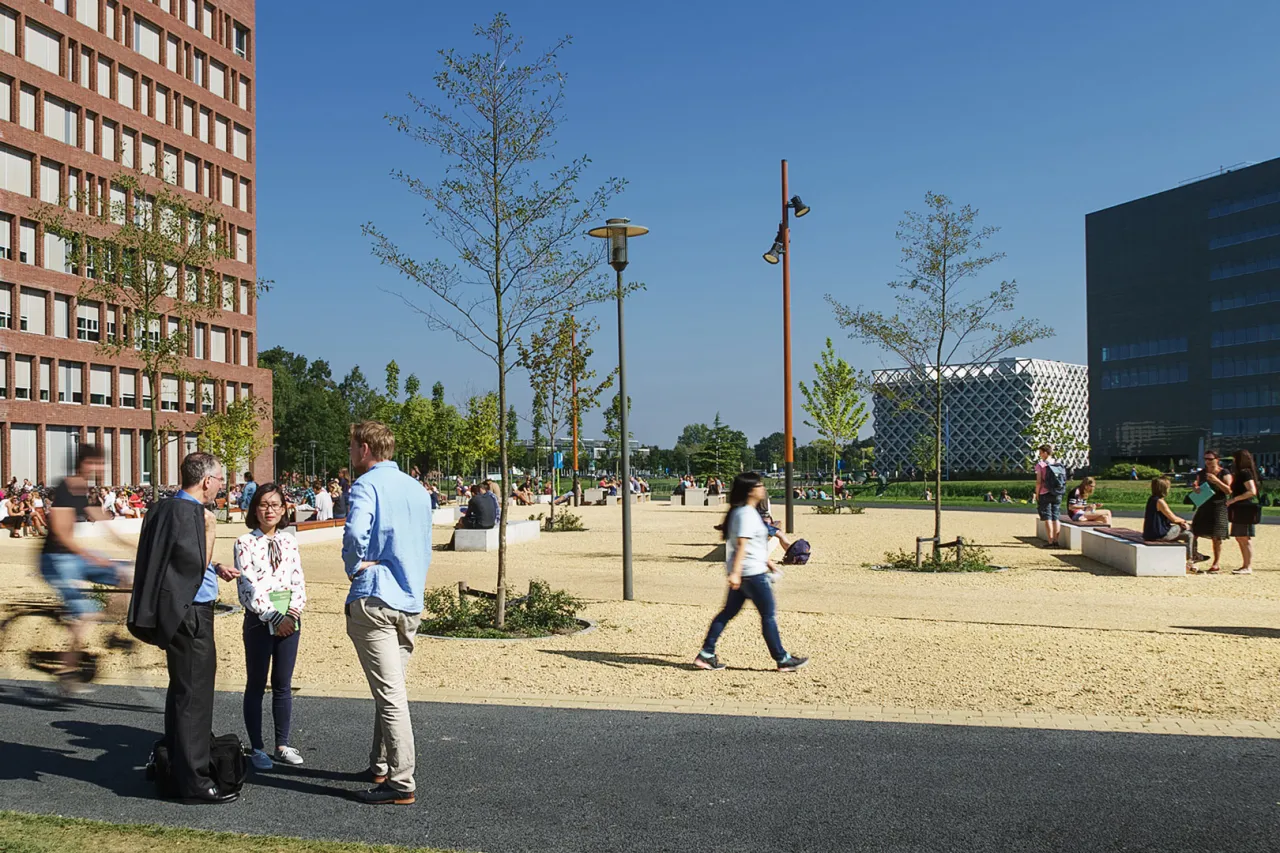
You will work on the greenest and most innovative campus in the Netherlands, in an international and open working environment.
Coming from abroad
Wageningen University & Research is the university and research centre for life sciences. The themes we deal with are relevant to everyone around the world and Wageningen, therefore, has a large international community and a lot to offer to international employees.
Because we expect you to work and live in the Netherlands our team of advisors on Dutch immigration procedures will help you with the visa application procedures for yourself and, if applicable, for your family.
Feeling welcome also has everything to do with being well informed. Wageningen University & Research's International Community page contains practical information about what we can do to support international employees coming to Wageningen. Furthermore, our Welcome Center can assist you with any additional advice and information about for example housing, opening a bank account, dual career programs or schooling. Finally, certain categories of international staff may be eligible for a tax exemption on a part of their salary during the first five years in the Netherlands.
Important information
For more information about the position, please contact Dr. Kirsty Holstead, via email: kirsty.holstead@wur.nl
Questions about the procedure? Get in touch with Noorien Abbas, Corporate Recruiter, via recruitment.ssg@wur.nl
Ready to apply?
You can apply directly using the apply button on the vacancy page on our website which will allow us to process your personal information with your approval. Only applications submitted through our website will be considered.
To apply, please send the following documents:
- Complete and up-to-date curriculum vitae (max 2 pages);
- Motivation letter(max 1 page).
The maximum length of the documents must not exceed 3 pages. If it exceeds, applications will not be considered. Additional files such as grades and transcripts are not required during this stage and will not be considered.
You can apply until 23 June 2026. The first interviews are scheduled tentatively for 9 and 10 July 2026.
Welcome, safe, and valued
Wageningen University & Research (WUR) highly values diversity and inclusion because we believe that different insights lead to innovative solutions. We create a work environment where everyone feels welcome, safe, and appreciated, regardless of background, identity, or experience. Together, we are building a culture where everyone's unique contribution adds to the success of our organization.
We are
The mission of Wageningen University & Research is “To explore the potential of nature to improve the quality of life”. Under the banner Wageningen University & Research, Wageningen University and the specialised research institutes of the Wageningen Research Foundation have joined forces in contributing to finding solutions to important questions in the domain of healthy food and living environment. With its roughly 30 branches, 7,600 employees (6,700 fte) and 13,100 students and over 150,000 participants to WUR’s Life Long Learning, Wageningen University & Research is one of the leading organisations in its domain. The unique Wageningen approach lies in its integrated approach to issues and the collaboration between different disciplines.
Read the 5 reasons why your future colleagues enjoy working at WUR and watch the video below to get an idea of our green campus!
We will recruit for the vacancy ourselves, so no employment agencies please. However, sharing in your network is appreciated.