PhD position in modelling the formation and flooding of coastal peat landscapes
Career at WUR
About us- Plenty of variety and challenges
- Pleasant working atmosphere
- Time for personal development
- Proper work-life balance
- Internationally leading
Your job
Are you fascinated by how water, sediment and vegetation shape coastal landscapes? Would you like to use numerical models to reconstruct the formation and flooding of peat landscapes during the Holocene, to better understand coastal landscape development under future sea-level rise? And are you eager to work in an interdisciplinary research team? Then this PhD position may be for you!
Zeeland is a low-lying coastal province in the south-western part of the Netherlands. During the Holocene, large parts of the region developed into an extensive peat landscape. Following a combination of sea-level rise, natural landscape dynamics and human land use, this landscape was flooded and transformed into the tidal environment it is today.
As a PhD candidate, you will investigate the processes behind these major landscape changes. You will translate existing geological records and paleo-tidal reconstructions into morphological and hydrodynamic boundary conditions for new numerical model simulations. In turn, you will validate the simulated coastal landscape development with the available paleo-records.
You will work with numerical models such as Delft3D, to capture interactions between hydrodynamics, sediment transport, morphology, and peat dynamics. The model studies will help to unravel how these bio-physical interactions have, over centuries to millennia, formed the Zeeland peat landscape and caused its subsequent rapid flooding.
This PhD position is part of Re-Flex Zeeland, an interdisciplinary project funded by the Delta Climate Center. The project brings together Wageningen University, Utrecht University, the Royal Netherlands Institute for Sea Research (NIOZ), and regional partners. Although the project focuses on Zeeland, it addresses internationally relevant questions about the resilience and vulnerability of low-lying deltas under sea-level rise, land subsidence and human intervention.
Within the Re-Flex Zeeland project, you will collaborate closely with another PhD candidate working on geological and vegetation reconstructions, and with a postdoctoral researcher developing three-dimensional visualizations of the past landscapes.
Your duties and responsibilities include:
- developing, calibrating and evaluating numerical models that couple hydrodynamics, sediment transport, morphology and vegetation dynamics;
- translating geological and paleo-tidal reconstructions into model configurations;
- designing numerical experiments to investigate the formation and flooding of coastal peat landscapes;
- collaborating with researchers at Wageningen University, Utrecht University, NIOZ and the Delta Climate Center;
- publishing your findings in scientific journals and presenting them at international conferences;
- supervising BSc and MSc thesis students, and contributing to field excursions in Zeeland as part of BSc and MSc education;
- completing a PhD thesis.
You will work here
We are the Hydrology and Environmental Hydraulics Group (HWM), a dynamic and committed team of academics, support staff, postdocs and PhD researchers. Our focus is on hydrology and environmental hydraulics, which we combine to understand and quantify hydrological processes in catchments, aquifers, rivers and deltas. We develop novel sensing techniques, create models and perform field and lab experiments to advance process understanding.
You will be supervised by Roeland van de Vijsel and Ton Hoitink, and will work closely together with other researchers in the Re-Flex Zeeland project.
Your working time will be divided between Wageningen University, and the Delta Climate Center in Vlissingen, a coastal city in Zeeland. The exact balance will be agreed at the start of the appointment. Regular presence at both locations and travel between them will be expected.
Your qualities
For this project, we are looking for a highly motivated PhD candidate. You are curious and analytical and have a strong interest in coastal and delta landscapes. You are enthusiastic about linking geological data with numerical modelling and can work independently while contributing to an interdisciplinary team.
You also have:
- a completed MSc degree in earth sciences, hydraulic or coastal engineering, physical oceanography, physical geography, or a related field;
- a strong background in hydrodynamics, morphodynamics or sediment transport;
- experience with numerical modelling;
- programming skills in, for example, Python, MATLAB, or similar;
- experience with spatial or time-series data;
- good scientific writing and presentation skills;
- willingness to work regularly in both Wageningen and Vlissingen.
For this position your command of the English language is expected to be at C1 level. Sometimes it is necessary to submit an internationally recognised Certificate of Proficiency in the English Language. More information can be found here.
Knowledge of the Dutch language is preferred.
We offer
Wageningen University & Research offers excellent terms of employment. A few highlights from our Collective Labour Agreement include:
- Partially paid parental leave;
- working hours that can be discussed and arranged so that they allow for the best possible work-life balance;
- there is a strong focus on vitality and you can make use of the sports facilities available on campus for a small fee;
- a fixed year-end bonus of 8.3%;
- excellent pension scheme.
In addition to these first-rate employee benefits, you will receive a fully funded PhD position and you will be offered a course program tailored to your needs and the research team.
The gross salary for the first year is € 3.204,- per month rising to € 4.051,- in the fourth year in according to the Collective Labour Agreements for Dutch Universities (CAO-NU) (scale P). This is based on a full-time working week of 38 hours. We offer a temporary contract for 18 months which will be extended for the duration of the project if you perform well.
We encourage development and internal mobility within our organisation. Our recruitment and selection policy sets out the conditions that apply specifically to you as a (former) employee. If you have any questions, we are happy to help.
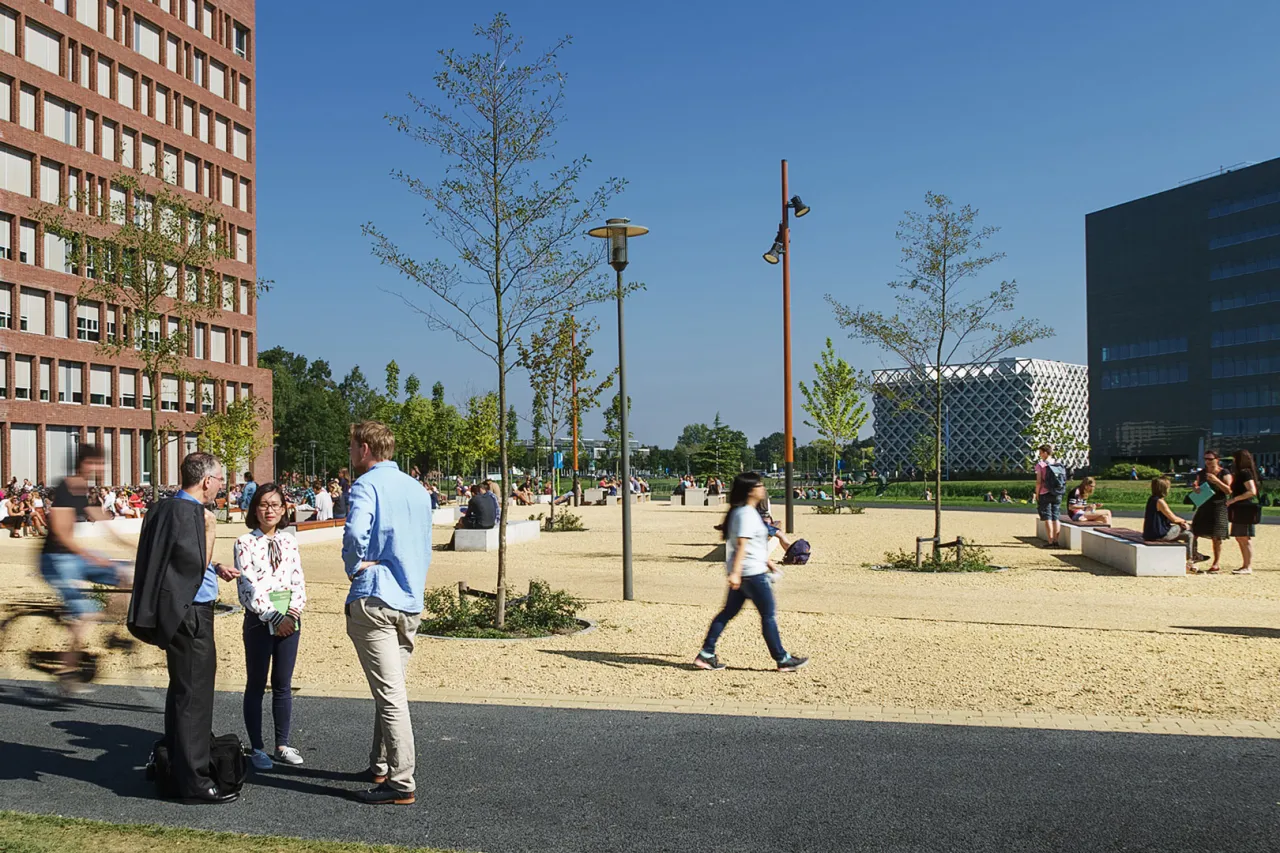
You will work on the greenest and most innovative campus in the Netherlands, in an international and open working environment.
Coming from abroad
Wageningen University & Research is the university and research centre for life sciences. The themes we deal with are relevant to everyone around the world and Wageningen, therefore, has a large international community and a lot to offer to international employees.
Because we expect you to work and live in the Netherlands our team of advisors on Dutch immigration procedures will help you with the visa application procedures for yourself and, if applicable, for your family.
Feeling welcome also has everything to do with being well informed. Wageningen University & Research's International Community page contains practical information about what we can do to support international employees coming to Wageningen. Furthermore, our Welcome Center can assist you with any additional advice and information about for example housing, opening a bank account, dual career programs or schooling. Finally, certain categories of international staff may be eligible for a tax exemption on a part of their salary during the first five years in the Netherlands.
Important information
For more information about the position, please contact Roeland van de Vijsel, Assistant Professor of Environmental Hydraulics, or Ton Hoitink, Professor of Earth System Sciences.
Questions about the procedure? Get in touch with Jessa Rozema, Corporate Recruiter, via jessa.rozema-stol@wur.nl
Ready to apply?
You can apply directly using the apply button on the vacancy page on our website which will allow us to process your personal information with your approval. Only applications submitted through our website will be considered.
To apply, please send the following documents (max. 3 pages in total ):
- Complete and up-to-date curriculum vitae (max. 2 pages);
- Motivation letter (max. 1 page).
The maximum length of the documents must not exceed 3 pages. If it exceeds, applications will not be considered. Additional files such as grades and transcripts are not required during this stage and will not be considered.
You can apply up to and including 25 October 2026.
Additional information form
For this position, you must fill in a mandatory form which will allow us to have a comprehensive view of your qualifications and better assess your fit for it. You can access the form using the link below:
PhD position in modelling the formation and flooding of coastal peat landscapes – Fill out form
Your prompt response will ensure that your application continues to move forward in the evaluation process. We assure you that the information provided will be kept confidential and used solely for this application process.
Welcome, safe, and valued
Wageningen University & Research (WUR) highly values diversity and inclusion because we believe that different insights lead to innovative solutions. We create a work environment where everyone feels welcome, safe, and appreciated, regardless of background, identity, or experience. Together, we are building a culture where everyone's unique contribution adds to the success of our organization.
We are
The mission of Wageningen University & Research is “To explore the potential of nature to improve the quality of life”. Under the banner Wageningen University & Research, Wageningen University and the specialised research institutes of the Wageningen Research Foundation have joined forces in contributing to finding solutions to important questions in the domain of healthy food and living environment. With its roughly 30 branches, 7,600 employees (6,700 fte) and 13,100 students and over 150,000 participants to WUR’s Life Long Learning, Wageningen University & Research is one of the leading organisations in its domain. The unique Wageningen approach lies in its integrated approach to issues and the collaboration between different disciplines.
Read the 5 reasons why your future colleagues enjoy working at WUR and watch the video below to get an idea of our green campus!
We will recruit for the vacancy ourselves, so no employment agencies please. However, sharing in your network is appreciated.