PhD: State-Dependent Spatial Representations using immersive Virtual Reality
Career at WUR
About us- Plenty of variety and challenges
- Pleasant working atmosphere
- Time for personal development
- Proper work-life balance
- Internationally leading
Your job
Are you fascinated by how people understand, navigate, and communicate complex spatial environments? Do you hold a master’s degree in cognitive science, environmental psychology, human-computer interaction, geo-information science, or a related field, with experience in experimental research using virtual reality? If so, we have an exciting PhD opportunity for you!
Spatial thinking plays a crucial role in understanding and communicating environmental issues, from climate adaptation and landscape planning to biodiversity loss, water management, and sustainable land use. These challenges often require people to reason about spatial processes that are not immediately visible: future scenarios, delayed consequences, cascading effects, or changes that unfold across places and time. To support better environmental decision-making and communication, we need to understand how people build mental representations of such complex, dynamic spatial systems.
Spatial cognition research has traditionally studied how people represent environments through concepts such as mental models, cognitive maps, and cognitive graphs. These approaches have provided important insights into how people perceive locations, learn route layouts, and understand spatial relations. However, they are primarily suited to stable environments and are less equipped to handle situations where the same place or action may have different spatial meaning or outcomes depending on context — for example, a landscape that changes with climate, or a local action that produces effects in another part of the system.
This PhD project investigates how people learn, update, and use spatial knowledge when the structure or meaning of an environment depends on hidden or changing conditions, which we refer to as state-dependent environments. Rather than treating spatial knowledge as a static map, the project asks how people construct and reason with representations that capture not only where things are, but also the conditions under which spatial relations hold, and how immersive virtual reality and behavioural data such as movement, interaction, and eye-tracking can be used to study this process.
Specific research objectives
Develop VR-based experimental tasks to study how people learn and update spatial representations during active exploration in different types of state-dependent environments.
Identify behavioural patterns of state-dependent spatial reasoning that reveal how people detect, anticipate, and adapt to the intertwined relations between spatial structure and its underlying conditions.
Establish the conditions under which state-dependent spatial representations generalise beyond the learned environment, and what individual and contextual factors predict successful knowledge transfer across virtual-virtual and/or virtual-real contexts.
The outcome will contribute to new concepts and methods for studying spatial cognition as a dynamic, predictive, and adaptive process, with broader relevance to environmental communication, systems thinking, and adaptive decision making.
You will work here
The research is embedded within the chair Laboratory for Geo-information Science and Remote Sensing (GRS) which is led by Prof. Sytze de Bruin. You will be supervised by Dr. Jiayan Zhao, and co-supervised by Prof. Arnold Bregt and Prof. Sytze de Bruin.
Your qualities
As a PhD researcher, you should have:
- A completed, or soon to be completed, MSc (or equivalent) degree in cognitive science, environmental psychology, human-computer interaction, geo-information science, or related field.
- An established background and/or keen interest in spatial cognition, including topics such as spatial learning, navigation, and environmental perception and behavior.
- Hands-on experience in designing and using immersive virtual environments and software (e.g. Unity).
- Experience in conducting empirical research (e.g., experimental design, instrument selection, recruitment, participant testing, and report writing);
- Experience in quantitative data analysis and visualizations with R and/or Python;
- Interest in working with behavioral data, such as movement trajectories, interaction logs, task performance, and eye-tracking data;
- Excellent English communication skills, both written and spoken.
- Motivation, curiosity, creativity, and willingness to work in an interdisciplinary research team.
For this position your command of the English language is expected to be at C1 level. Sometimes it is necessary to submit an internationally recognised Certificate of Proficiency in the English Language. More information can be found here.
We offer
Wageningen University & Research offers excellent terms of employment. A few highlights from our Collective Labour Agreement include:
- Partially paid parental leave;
- working hours that can be discussed and arranged so that they allow for the best possible work-life balance;
- there is a strong focus on vitality and you can make use of the sports facilities available on campus for a small fee;
- a fixed year-end bonus of 8.3%;
- excellent pension scheme.
In addition to these first-rate employee benefits, you will receive a fully funded PhD position and you will be offered a course program tailored to your needs and the research team.
The gross salary for the first year is € 3.059,- per month rising to € 3.881,- in the fourth year in according to the Collective Labour Agreements for Dutch Universities (CAO-NU) (scale P). This is based on a full-time working week of 38 hours. We offer a temporary contract for 18 months which will be extended for the duration of the project if you perform well.
We encourage development and internal mobility within our organisation. Our recruitment and selection policy sets out the conditions that apply specifically to you as a (former) employee. If you have any questions, we are happy to help.
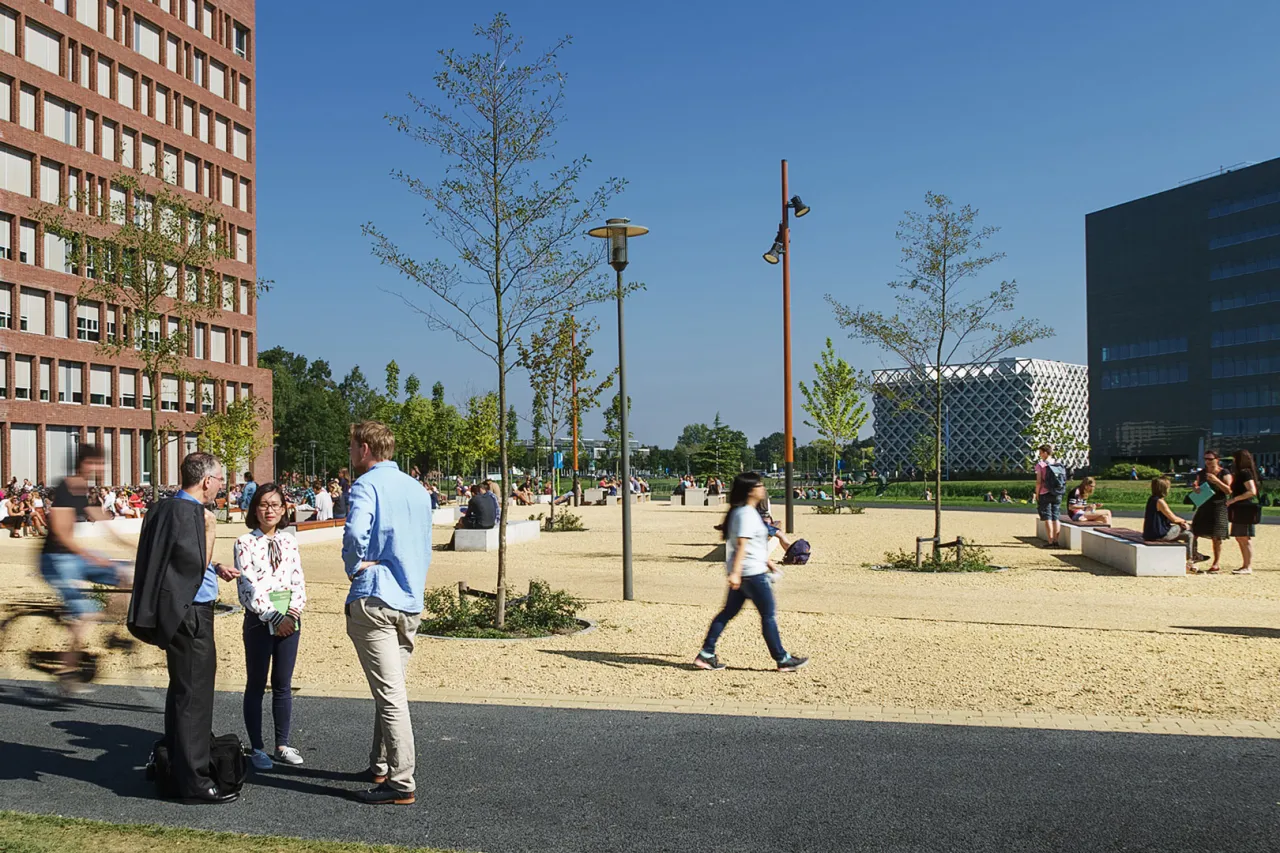
You will work on the greenest and most innovative campus in the Netherlands, in an international and open working environment.
Coming from abroad
Wageningen University & Research is the university and research centre for life sciences. The themes we deal with are relevant to everyone around the world and Wageningen, therefore, has a large international community and a lot to offer to international employees.
Because we expect you to work and live in the Netherlands our team of advisors on Dutch immigration procedures will help you with the visa application procedures for yourself and, if applicable, for your family.
Feeling welcome also has everything to do with being well informed. Wageningen University & Research's International Community page contains practical information about what we can do to support international employees coming to Wageningen. Furthermore, our Welcome Center can assist you with any additional advice and information about for example housing, opening a bank account, dual career programs or schooling. Finally, certain categories of international staff may be eligible for a tax exemption on a part of their salary during the first five years in the Netherlands.
Important information
For more information about the position, please contact Jiayan Zhao jiayan.zhao@wur.nl, Assistant Professor, and/or Sytze de Bruin Sytze.debruin@wur.nl, professor and chairholder.
Questions about the procedure? Get in touch with Jessa Rozema, Corporate Recruiter, via Jessa.Rozema-stol@wur.nl.
Ready to apply?
You can apply directly using the apply button on the vacancy page on our website which will allow us to process your personal information with your approval. Only applications submitted through our website will be considered.
To apply, please send the following documents (max. 3 pages in total ):
- Complete and up-to-date curriculum vitae (max. 2 pages);
- Motivation letter (max. 1 page).
The maximum length of the documents must not exceed 3 pages. If it exceeds, applications will not be considered. Additional files such as grades and transcripts are not required during this stage and will not be considered.
You can apply up to and including August 7, 2026. We hope to schedule the first interviews in the first week of September.
Welcome, safe, and valued
Wageningen University & Research (WUR) highly values diversity and inclusion because we believe that different insights lead to innovative solutions. We create a work environment where everyone feels welcome, safe, and appreciated, regardless of background, identity, or experience. Together, we are building a culture where everyone's unique contribution adds to the success of our organization.
We are
The mission of Wageningen University & Research is “To explore the potential of nature to improve the quality of life”. Under the banner Wageningen University & Research, Wageningen University and the specialised research institutes of the Wageningen Research Foundation have joined forces in contributing to finding solutions to important questions in the domain of healthy food and living environment. With its roughly 30 branches, 7,600 employees (6,700 fte) and 13,100 students and over 150,000 participants to WUR’s Life Long Learning, Wageningen University & Research is one of the leading organisations in its domain. The unique Wageningen approach lies in its integrated approach to issues and the collaboration between different disciplines.
Read the 5 reasons why your future colleagues enjoy working at WUR and watch the video below to get an idea of our green campus!
We will recruit for the vacancy ourselves, so no employment agencies please. However, sharing in your network is appreciated.