Postdoc: Evolution of Taste Receptors in Specialist Insect–Plant Interactions
Career at WUR
About us- Plenty of variety and challenges
- Pleasant working atmosphere
- Time for personal development
- Proper work-life balance
- Internationally leading
Your job
Are you a highly motivated and curious Post-doc with a strong interest in the evolution of sensory systems and how these sensory adaptations influence the coevolution of animals and plants? Do you want to explore how butterflies recognize and adapt to their host plants, and to contribute to cutting-edge research at the intersection of evolutionary biology and sensory ecology? Then we at Wageningen University & Research have an exciting opportunity for you.
In this Post-doc project, you will unravel the function of butterfly taste receptor neurons by determining to which plant compounds they respond and what role they play during the coevolution of butterflies and their host plants, using a novel molecular approach. Insects and plants are intertwined in an intimate coevolutionary arms race in which plants produce toxic defence compounds and insect herbivores in turn evolved specific detoxification mechanisms. In parallel to these feeding adaptations, insects also evolved specific detection mechanisms for those plants to which they have become adapted, to select suitable plants for feeding or for laying their eggs.
We will use the model system of the monarch butterflies, Danaus plexippus. These insects lay their eggs almost exclusively on plants containing cardenolides, toxic compounds to which these insects have specifically adapted. We will express the candidate receptor genes in a cell-based assay to test their responses in vitro. Through these analysis, we will not only gain information about the compounds these receptors detect, but also on their ecological and evolutionary relevance. In addition, we will create mutant butterflies lacking the most relevant candidate receptor genes using Crispr/Cas9, to unravel the role of different receptors and taste neurons during host-plant recognition. Combined, these results will provide a unique insight into the sensory mechanisms underlying the coevolution of insects and plants, which is a major driving factor of biodiversity and has shaped many of today’s terrestrial (agro-) ecosystems.
As a Post-doc, you will contribute to fundamental research in the context of insect-plant coevolution. You will be embedded in a diverse group of international scientists and collaborate with colleagues from both in- and outside Wageningen University & Research. You will be involved in the supervision of PhD-candidates as well as MSc- and BSc-students, and assist in teaching courses.
You will work here
The research is embedded within the Laboratory of Entomology Lab of Entomology - WUR, which is led by Prof. Bregje Wertheim (Bregje Wertheim - Wageningen University & Research). You will be co-supervised by Dr. Alexander Haverkamp (Alexander Haverkamp - Wageningen University & Research). In addition, you will also be embedded in the PE&RC graduate school (Home | PE&RC), which will allow you to follow a wide variety of training courses and provide support during your academic journey.
This position is part of the Academic Career Framework (ACF) at Wageningen University & Research.
Your qualities
For this project we are looking for an enthusiastic and skilled Post-doc with a strong interest in the evolution of insects taste receptors and the coevolution of insects and plants, who is experienced in working at the intersection of sensory physiology, molecular biology and chemical ecology.
You also possess:
a PhD in Biology, neurobiology, evolutionary ecology or a related field;
a strong background in sensory ecology and evolutionary biology;
experience in cell receptor assays, behavioral analysis and phylogenetic analysis;
applications for further personal grants is appreciated;
excellent communication skills in English and experience with scientific publishing;
- a creative and proactive team player that would like to work in a multidisciplinary environment.
In our international working environment there is an increasing amount of communication in English. For this position it is about language level C1 .
We offer
Wageningen University & Research offers excellent terms of employment. A few highlights from our Collective Labour Agreement include:
- sabbatical leave, study leave, and partially paid parental leave;
- working hours that can be discussed and arranged so that they allow for the best possible work-life balance;
- there is a strong focus on vitality and you can make use of the sports facilities available on campus for a small fee;
- a fixed year-end bonus of 8.3%;
- excellent pension scheme.
In addition to these first-rate employee benefits, you will of course receive a good salary. Depending on your experience, we offer a competitive gross salary of between € 3.546,- and € 5.538,- for a full-time working week of 38 hours, in accordance with the Collective Labour Agreements for Dutch Universities (CAO-NU) (scale 10). As for your contract, we initially offer a one-year contract that can be extended - if possible within (company) organizational circumstances - on good performance, for the duration of the project.
We encourage development and internal mobility within our organisation. Our recruitment and selection policy sets out the conditions that apply specifically to you as a (former) employee. If you have any questions, we are happy to help.
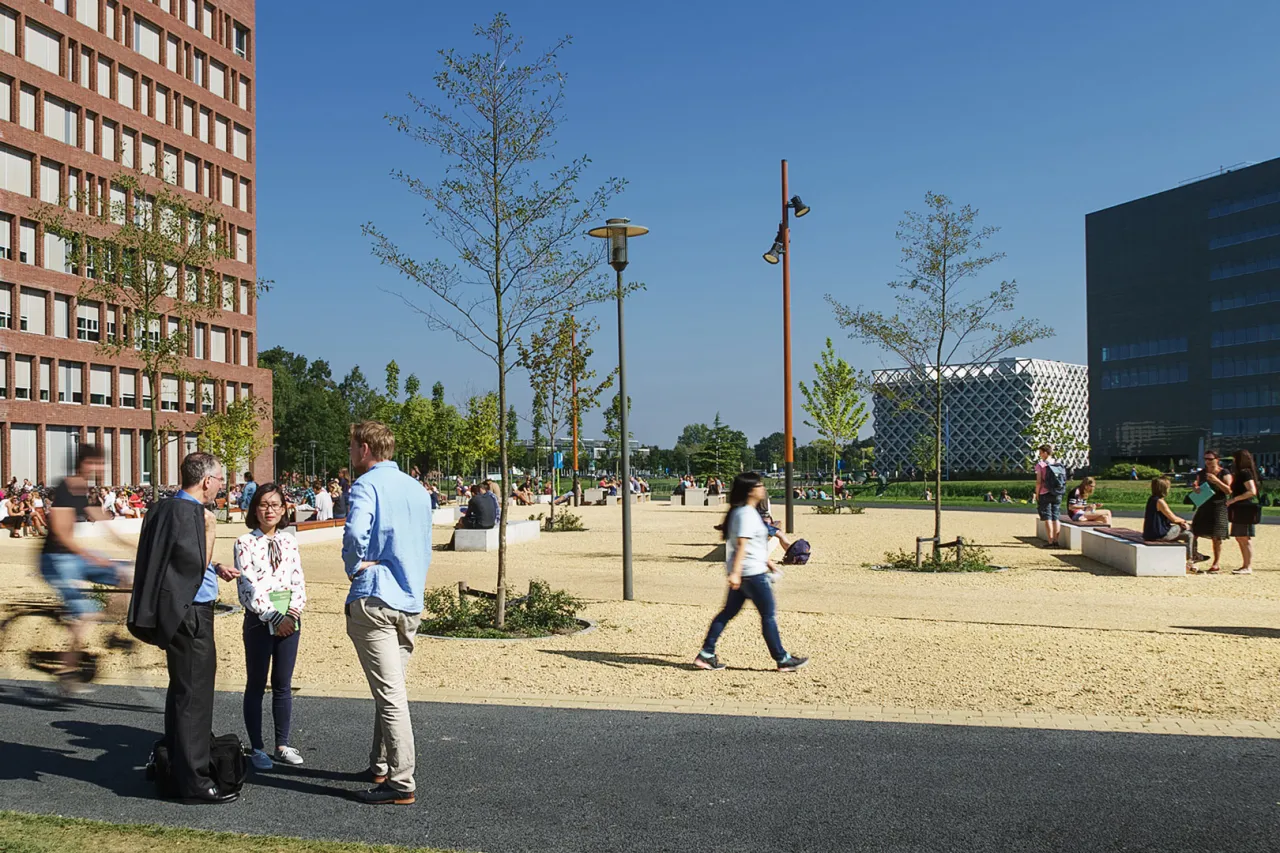
You will work on the greenest and most innovative campus in the Netherlands, in an international and open working environment.
Coming from abroad
Wageningen University & Research is the university and research centre for life sciences. The themes we deal with are relevant to everyone around the world and Wageningen, therefore, has a large international community and a lot to offer to international employees.
Because we expect you to work and live in the Netherlands our team of advisors on Dutch immigration procedures will help you with the visa application procedures for yourself and, if applicable, for your family.
Feeling welcome also has everything to do with being well informed. Wageningen University & Research's International Community page contains practical information about what we can do to support international employees coming to Wageningen. Furthermore, our Welcome Center can assist you with any additional advice and information about for example housing, opening a bank account, dual career programs or schooling. Finally, certain categories of international staff may be eligible for a tax exemption on a part of their salary during the first five years in the Netherlands.
Important information
For more information about the position, please contact Alexander Haverkamp, Assistant Professor, via email: alexander.haverkamp@wur.nl
Questions about the procedure? Get in touch with Noorien Abbas, Corporate Recruiter, via vacaturemeldingen.psg@wur.nl .
Ready to apply?
Click on the application button next to the vacancy on our website. Only applications submitted through our website will be considered.
You can apply up to and including 30 June 2026. The first interviews will be scheduled soon after the closing date. Internal candidates are preferred to apply before 19 June 2026.
Procedure
As part of our selection process, an assessment may be incorporated within the procedure
Welcome, safe, and valued
Wageningen University & Research (WUR) highly values diversity and inclusion because we believe that different insights lead to innovative solutions. We create a work environment where everyone feels welcome, safe, and appreciated, regardless of background, identity, or experience. Together, we are building a culture where everyone's unique contribution adds to the success of our organization.
We are
The mission of Wageningen University & Research is “To explore the potential of nature to improve the quality of life”. Under the banner Wageningen University & Research, Wageningen University and the specialised research institutes of the Wageningen Research Foundation have joined forces in contributing to finding solutions to important questions in the domain of healthy food and living environment. With its roughly 30 branches, 7,600 employees (6,700 fte) and 13,100 students and over 150,000 participants to WUR’s Life Long Learning, Wageningen University & Research is one of the leading organisations in its domain. The unique Wageningen approach lies in its integrated approach to issues and the collaboration between different disciplines.
Read the 5 reasons why your future colleagues enjoy working at WUR and watch the video below to get an idea of our green campus!
We will recruit for the vacancy ourselves, so no employment agencies please. However, sharing in your network is appreciated.