Postdoc in hyperspectral satellite sensor harmonisation in space and time
Career at WUR
About us- Plenty of variety and challenges
- Pleasant working atmosphere
- Time for personal development
- Proper work-life balance
- Internationally leading
Your job
Are you motivated by having real impact on the scientific community by developing open-source software for the next generation of hyperspectral satellite remote sensing? This postdoctoral researcher position at Wageningen University offers the opportunity to advance methods for hyperspectral cross-sensor harmonisation, while developing open-source research software that supports the monitoring of vegetation conditions and ecosystem functioning across scales.
The upcoming European Space Agency satellite missions CHIME and FLEX will mark a major step forward in spaceborne monitoring of vegetation and ecosystem functioning, by providing open global hyperspectral coverage at 30-100 m spatial resolution and predictable revisit intervals. Existing hyperspectral missions such as EnMAP, PRISMA, and DESIS provide a growing archive of complementary observations that can help monitor and understand ecosystem functioning, plant stress and chlorophyll fluorescence not just over space, but also going back in time. However, even though these datasets are complementary, they cannot be used together as a single time series due to differences in sensor characteristics, atmospheric correction algorithms, and spatial gridding.
To address the challenge of large-scale vegetation monitoring, Wageningen University leads the NWO-funded project Advancing hyperSpectral imaging for Cross-scale Ecosystem fuNctioning and vegeTation research (ASCENT). Within ASCENT, the Laboratory of Geo-information Science and Remote Sensing (GRS) is developing methods and open-source software to harmonise imagery from current hyperspectral satellite missions with the specifications of future missions FLEX and CHIME, while ensuring compatibility with the broader ecosystem of upcoming Earth observation products.
As a postdoctoral researcher working on the ASCENT project at GRS, you will contribute to this challenge by developing state-of-the-art algorithms and open-source software for hyperspectral cross-sensor harmonisation. Your work will enable researchers worldwide to seamlessly integrate data from multiple satellite missions, supporting applications ranging from vegetation monitoring and ecosystem functioning to agriculture and biodiversity assessment. You will also have an opportunity to be involved in other project activities and education within GRS.
Your duties and responsibilities include
- Designing and developing methods for harmonisation of hyperspectral and multispectral imagery from different spaceborne sensors,
- Developing, validating and publishing an open-source harmonisation tool that produces analysis-ready hyperspectral data cubes,
- Collaborating with researchers across the ASCENT consortium and contributing to the integration of the developed tools into broader project activities, and
- Publishing in leading peer-reviewed journals and communicating findings to scientific and stakeholder audiences.
Your team
You will work within the Laboratory of Geoinformation Science and Remote Sensing, part of the Department of Environmental Sciences at Wageningen University. You will be supported by a group of researchers working on global-to-local-scale land monitoring, imaging spectroscopy, and time series analysis. Within the same chair group, you will work together with a PhD candidate within the ASCENT project, who will focus on hyperspectral satellite imagery calibration and validation using in-situ data acquisition, radiative transfer modelling and plant trait retrieval.
The position is embedded in a strong interdisciplinary and collaborative research environment, as the ASCENT project involves eight research institutions in the Netherlands. The position will be supported by particularly close cross-disciplinary collaboration with theoretical ecology and vegetation monitoring researchers from the ASCENT consortium.
You will work here
The Laboratory of Geo-Information Science and Remote Sensing (GRS) is part of the Department of Environmental Sciences. The Department’s fundamental research and education focus on our living environment, encompassing nature, landscape, land use, mitigation and adaptation to climate change, water management, and various competing claims on space.
The mission of our laboratory is to advance spatial competencies for a sustainable world through research and education. The research conducted in the laboratory has a fundamental character, with a clear link to the mission of Wageningen University to provide Science for Impact.
In recent years, the laboratory received excellent reviews in both research and education, and is very international in terms of staff and student composition.
Your qualities
You are a highly motivated and independent researcher with strong programming skills and methodological skills in optical remote sensing. You have a clear interest in developing open-source software to support remote sensing research. You combine scientific rigor with the ability to work collaboratively in an international research environment and to translate methodological advances into actionable software.
You also possess
- A PhD in remote sensing, geoinformatics, computer science, atmospheric sciences, or related fields;
- Experience in software engineering, including algorithm development and applications on big Earth Observation data, e.g. using data cubes on cloud computing platforms;
- Knowledge and experience on working with diverse data sources with spectral, spatial and temporal variabilities;
- Familiarity with hyperspectral remote sensing data and optical spectroscopy;
- Experience with time series analysis and temporal gap filling techniques, e.g. machine learning, deep learning, and/or statistical techniques;
- Familiarity with sensor harmonisation (incl. geometric co-registration, spectral resampling), calibration and validation techniques for satellite sensors (incl. uncertainty assessment), atmospheric correction and/or radiative transfer modelling (e.g. MODTRAN, SCOPE), would be considered advantages for this position.
In our international working environment there is an increasing amount of communication in English. For this position it is about language level C1 .
We offer
Wageningen University & Research offers excellent terms of employment. A few highlights from our Collective Labour Agreement include:
- sabbatical leave, study leave, and partially paid parental leave;
- working hours that can be discussed and arranged so that they allow for the best possible work-life balance;
- there is a strong focus on vitality and you can make use of the sports facilities available on campus for a small fee;
- a fixed year-end bonus of 8.3%;
- excellent pension scheme.
In addition to these first-rate employee benefits, you will of course receive a good salary. Depending on your experience, we offer a competitive gross salary of between € 3.706,- and € 5.760,- for a full-time working week of 38 hours, in accordance with the Collective Labour Agreements for Dutch Universities (CAO-NU) (scale 10). As for your contract, we initially offer a one-year contract that can be extended - if possible within (company) organizational circumstances - on good performance, for the duration of the project.
We encourage development and internal mobility within our organisation. Our recruitment and selection policy sets out the conditions that apply specifically to you as a (former) employee. If you have any questions, we are happy to help.
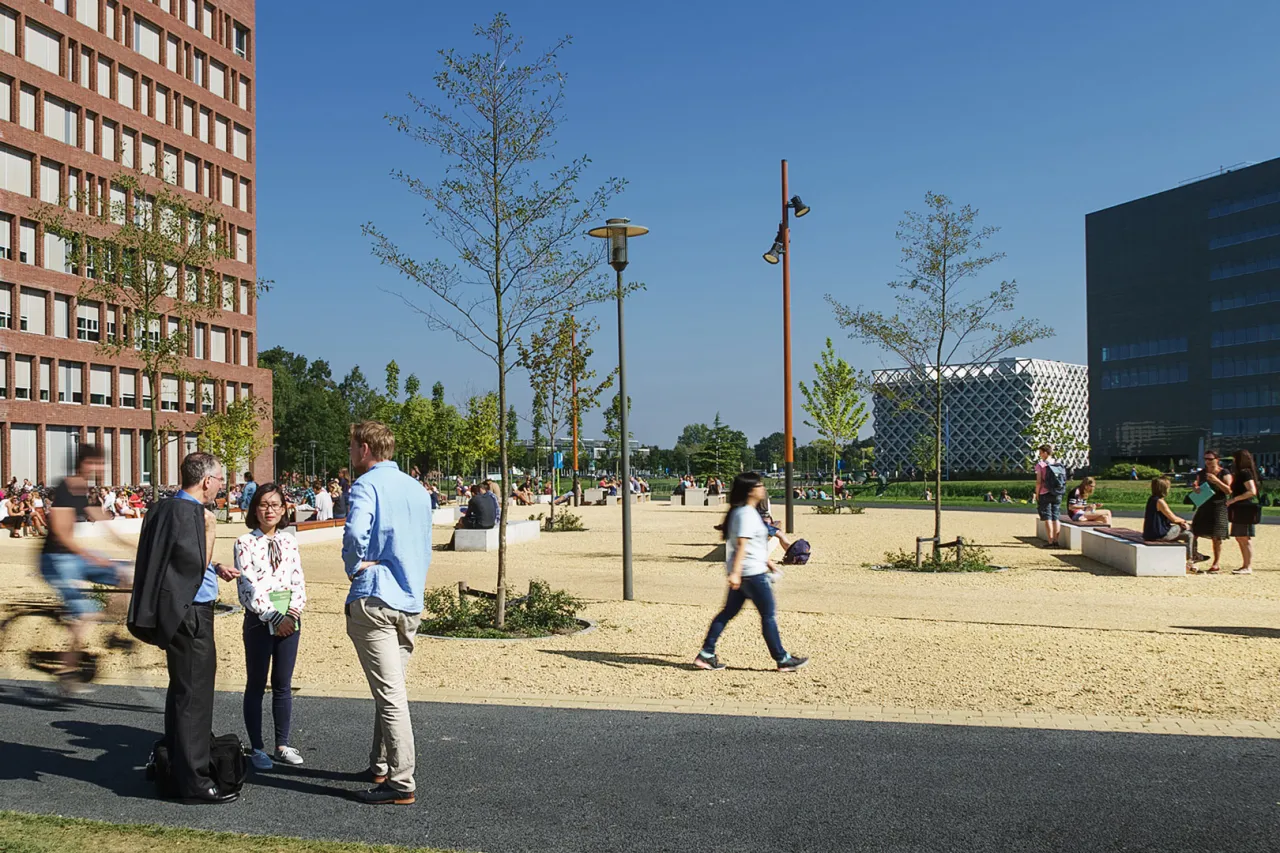
You will work on the greenest and most innovative campus in the Netherlands, in an international and open working environment.
Coming from abroad
Wageningen University & Research is the university and research centre for life sciences. The themes we deal with are relevant to everyone around the world and Wageningen, therefore, has a large international community and a lot to offer to international employees.
Because we expect you to work and live in the Netherlands our team of advisors on Dutch immigration procedures will help you with the visa application procedures for yourself and, if applicable, for your family.
Feeling welcome also has everything to do with being well informed. Wageningen University & Research's International Community page contains practical information about what we can do to support international employees coming to Wageningen. Furthermore, our Welcome Center can assist you with any additional advice and information about for example housing, opening a bank account, dual career programs or schooling. Finally, certain categories of international staff may be eligible for a tax exemption on a part of their salary during the first five years in the Netherlands.
Important information
For more information about the position, please contact Dainius Masiliunas, dainius.masiliunas@wur.nl
Questions about the procedure? Get in touch with Jessa Rozema, Corporate Recruiter, via jessa.rozema-stol@wur.nl.
Ready to apply?
Click on the application button next to the vacancy on our website. Only applications submitted through our website will be considered.
You can apply up to and including 7 December 2026. Internal candidates are preferred to apply before 16 November 2026.
To apply, please send the following documents:
- Complete and up-to-date curriculum vitae;
- Motivation letter.
Additional files such as grades and transcripts are not required during this stage and will not be considered.
Welcome, safe, and valued
Wageningen University & Research (WUR) highly values diversity and inclusion because we believe that different insights lead to innovative solutions. We create a work environment where everyone feels welcome, safe, and appreciated, regardless of background, identity, or experience. Together, we are building a culture where everyone's unique contribution adds to the success of our organization.
We are
The mission of Wageningen University & Research is “To explore the potential of nature to improve the quality of life”. Under the banner Wageningen University & Research, Wageningen University and the specialised research institutes of the Wageningen Research Foundation have joined forces in contributing to finding solutions to important questions in the domain of healthy food and living environment. With its roughly 30 branches, 7,600 employees (6,700 fte) and 13,100 students and over 150,000 participants to WUR’s Life Long Learning, Wageningen University & Research is one of the leading organisations in its domain. The unique Wageningen approach lies in its integrated approach to issues and the collaboration between different disciplines.
Read the 5 reasons why your future colleagues enjoy working at WUR and watch the video below to get an idea of our green campus!
We will recruit for the vacancy ourselves, so no employment agencies please. However, sharing in your network is appreciated.