'I know that Wageningen will look after my legacy well’ - the story of Greet Bierema
- Greet Bierema
- Bequeathing to WUR

Art van Grondelle
“Having a proper clear-out and finding a good home for everything gives me a sense of fulfilment.”
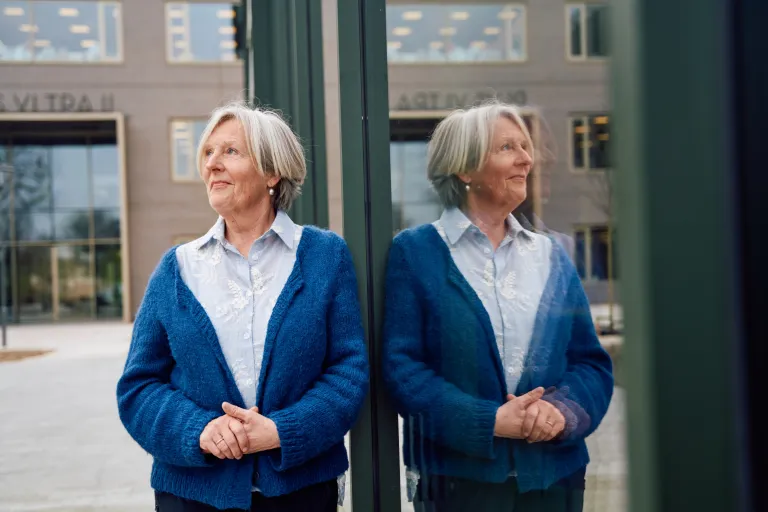
When Greet Bierema (72) looks back on her life, she sees, above all, how knowledge has always helped her move forward. From the farmstead in Groningen where she grew up to her years in Wageningen, where her world really opened up. Driven by that conviction, she decided to include WUR in her will. In the belief that knowledge makes a lasting difference, and that Wageningen brings that knowledge back to where it is needed most. "I am an observer who reads the world keenly, and I believe it is valuable to pass on what you have learnt."
Greet grew up in Usquert, a small village in North Groningen, in a staunchly socialist environment that has had a lasting influence on her view of the world. Farm life played a central role there; everyone knew one another. “The village was a small community in its own right. I was naturally observant, and that’s how I got to know almost all the locals.”
Her family was deeply involved in public life: her grandfather served in the Senate and the House of Representatives, whilst her father sat on various boards. When her parents had been married for 12.5 years, they took the family on a trip to places such as the Peace Palace and Margraten. “They wanted to teach us to look at the bigger picture. I was eleven, and I can still remember standing there in front of the Peace Palace. It made a huge impression on me.”
From Delft to Wageningen
Greet has dyslexia, although nobody knew that at the time. As a teenager, she wanted to become an architect and went with her parents to an open day in Delft, a train journey lasting a total of five hours. “In the auditorium, we saw about nine hundred boys and ten girls. My father turned round straight away and said, ‘You’re not going to study here’. I had to come up with something else.” In the library, she came across the ‘Landscape Architecture’ study programme in Wageningen in a course guide. The word ‘architecture’ was all Greet needed to know. Her father found it reassuring that there were more women studying in Wageningen, and the agricultural surroundings were more familiar to him.
Shortly after starting her degree, Greet was involved in a serious car accident whilst she was crossing the road in wonder to pick up a leaf from an American oak; the first time in her life she had seen one. Her legs were found to be shattered and she spent nine months in hospital. “There, too, I observed how people live together. Every new patient brought a new story.” Her fellow students had arranged amongst themselves that someone would visit her every week for nine months. “This kept me on track with my studies and gave me the confidence that I could make return to the programme.”
The search for informal leaders
During her studies, Greet discovered just how diverse Wageningen is. She particularly remembers the course in Public Information Studies. A quote from Professor Anne van den Ban has always stayed with her: ‘If you want to develop something, you have to align yourself with the informal leader’. Her initial dream of designing parks changed when her final-year supervisor drew her attention to her knowledge of farmsteads. He encouraged her to conduct research into this subject, on which she graduated in 1981.
Her first job took her into architectural world with a Delft-like atmosphere, where there was little knowledge of landscape architecture. “They thought I mainly knew about plants. They were surprised that I could think in the same way as they did.” As a woman, she had to prove herself all the more and was paid less than her male colleagues. Yet she carried on growing. In Staphorst, she worked on a huge project involving 800 farmsteads. “Because I needed access to the community, I asked the mayor who the informal leaders were. It turned out to be the church councils. Thanks to a snowball effect, it became a huge success.”

Art van Grondelle
Back to the farmstead
Chance brought her to Wageningen, and there too she was steered towards farmsteads - exactly where her roots lie. The practical work turned out to be a sort of further training. “You find yourself facing a harsh reality, quite different from that in the lecture halls.” In 2002, she set up her own consultancy, at a time when she felt ready for it. “I remember sitting in the car, looking out over the countryside and seeing the lights coming on in farmsteads everywhere. It was getting dark and I thought: I’ll take a leap into the unknown. I’m brave enough to do that.”
In 1989, Greet married her husband Berend. They were not married under the community of property regime; he was considerably older and already had grown-up children. “Because of that, I’ve always remained very independent. When we had a will drawn up in 2015, I thought very carefully about my estate. Part of it will go to my family, part to Groningen, part to the Twickel Estate where I worked for decades, and part to Wageningen.
Bringing knowledge back home
The Anne van den Ban Fund, part of the Wageningen University Fund, fits perfectly with what she considers important. The fund awards scholarships to talented students from low-income countries, who, after completing their studies, contribute to the development of their own countries. “I have seen at first hand that knowledge is more valuable than any development project. I love the idea of a student from Africa taking knowledge from Wageningen back home with them.” She regards her own years in Wageningen as formative: breaking away from her roots, broadening her horizons, and further developing her curiosity.
She still remembers how wonderful she found Wageningen on her first visit, when all the university buildings were still in the town centre. “Just like my home village, Wageningen was easy to find your way around.” She still feels part of the Wageningen community: through reunions, through people from Wageningen she met ‘along the way’, as she did - quite literally - during a stay in Bangladesh. “It really is a close-knit community. That’s why I trust that WUR will look after my legacy well. WUR gives me a good feeling.”
From observer to storyteller
At 72, Greet is still working. She keeps her knowledge up to date by staying active and describes her work as her lifestyle. Whilst observation and drawing were initially her main focus, she gradually became a storyteller as well. WUR would very much like to incorporate her archive on farmsteads. “Fellow landscape architects pointed out to me that it is a valuable reflection of the changes in the countryside, from agricultural operations to farmhouses, and from those who stay to those who leave. My work tells a story.”
Having her will drawn up made her think about her legacy. “I enjoy reflecting on the time that lies behind me and the time that lies ahead. Having a proper clear-out and finding a good home for everything gives me a sense of fulfilment. It brings me peace of mind to pass on my knowledge to people who can build on it, to students who will help shape the world in a positive way.”
A major source of inspiration for Greet was her aunt Tine, who had no children and devoted her time to Groningen’s culture. One of Tine’s sayings is particularly special to her: 'You must dedicate yourself to something of value; that gives meaning to your life.' That is exactly how Greet sees it. For her, not having children also means having the freedom to do other things. “Passing on knowledge and experience plays a part in your happiness in life. Why would you want to keep everything to yourself? Wealth lies in your mind.”
Questions?
Would you like to discuss the possibilities for bequeathing to WUR? Contact our Relationship Manager Legacies.
Bequeathing to WUR
A legacy to WUR is more than a gift. It is a lasting investment in knowledge, progress and solutions that transcend generations. Universities are breeding grounds for talent and innovation. Especially now - at a time of countless challenges, from climate change to medical breakthroughs - scientific research is invaluable. Legacies give the next generation of ambitious talent the opportunity to develop into changemakers for a sustainable future and to carry out innovative research.
Follow University Fund Wageningen on social media
Stay up-to-date and learn more through our social channels.