‘Wageningen never left me, and it’s now in my will’ - the story of Anne Marjan Greve
- Anne Marjan Greve
- Bequeathing to WUR

Art van Grondelle
“If I leave anything behind, I would like it to be in a place where knowledge is shared and opportunities are expanded.”
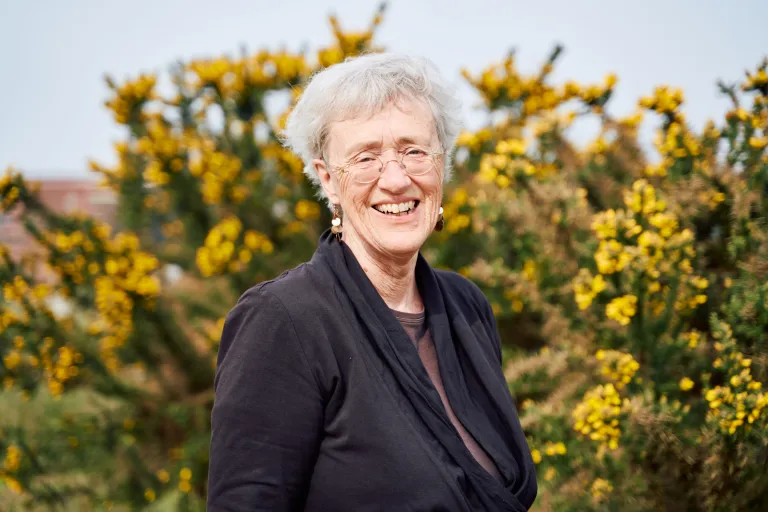
For Anne Marjan Greve (67), Wageningen runs like a thread through her life. She was born and raised there. After secondary school, she left the city to explore the world, but eventually returned. Her familiarity and natural connection with the university are now behind her decision to include WUR in her will. ‘It feels good to leave something behind to a place that has always been part of my life.’
Anne Marjan grew up in Wageningen-Hoog, a neighbourhood where the forest is just around the corner. Playing outside in nature was therefore something she took for granted. She would spend many afternoons identifying plants with her mother, who had a great knowledge of plants. “That’s where my love of nature began,” she says.
Her parents identified very strongly with Wageningen: both studied at the Agricultural College, which is where they met. The stories at the dinner table were often about student life, the city, the university and the people they met there. “I grew up in a Wageningen bubble. It wasn’t something I consciously thought about; it was just part of who we were.”
In secondary school, she opted for a science curriculum with mathematics, physics and chemistry. She loved to understand things, their cause and effect. And she was skilled with her hands, which made her mother suggest becoming a dentist. But when she was told, during a career information session, that women are better off becoming dental hygienists, she immediately ditched the idea. “That was not for me,” she says, looking back.
Urge to stand on her own two feet
As a teenager, she felt a strong need to get away from her familiar Wageningen surroundings. New impressions, new people: Anne Marjan wanted to learn about the big wide world. This desire took her to Delft, where she pursued a teacher training programme in biology and home economics. She enjoyed her time there, building a circle of friends and throwing herself wholeheartedly into student life.
A wish to gain more in-depth knowledge took her back to the city of her childhood when she decided to pursue a course in Home Economics there. It felt at once familiar and new. She knew Wageningen, but not as a student. Given that many of her friends lived in Delft, she did not have the busy student life that others experienced in Wageningen. “I didn’t have to discover anything and had already had a student life; I simply came home.”
While studying in Wageningen, she found out how broad many study programmes are. At a symposium, she saw all the places that Wageningen alumni have ended up: from policymaking to business, from healthcare to the economy. It confirmed her impression of Wageningen. “You learn to look at problems from so many different perspectives. I found that inspiring.”
Pioneering in a world full of technology
High unemployment in the 1980s saw her work opportunities dwindle. After a year of teaching in Amsterdam, she switched to an American automation company, a predecessor to Unisys. Computers were still in their infancy, and there was still a lot of inventing and explaining to do. Anne Marjan taught courses, often while still figuring out for herself exactly how the software worked. “We were pioneers. I loved that. My mother was also into computers, and I thought: if my mother can do this, so can I.”
In 1990, she was asked to switch to human resources. HRM was still being developed in the Netherlands at the time, but the US company she worked for was ahead of the game. She learnt about performance management, organisational cultures and human dynamics: topics that continue to fascinate her.
The work turned out to suit her extremely well. Ten years later, she started her own consulting practice as an independent HRM consultant. From 2000, she worked in this capacity for numerous organisations, each time with shorter commitments. “The variety, independence and sharp learning curve suited my character perfectly. And I often joked that my sell-by date was fast approaching.” After 25 years, she stopped working. These days, she spends her time teaching nature classes at IVN, among other things.

Art van Grondelle
Thinking about bequeathing: a decision that grew
When she moved back to Wageningen from Amsterdam 15 years ago and sat in the civil-law notary’s office to sign the deeds to the house she had just bought, she was asked if she had a will. That set her off on a relatively long process. “I had to think about it, and it was not solely a rational process. It was also really a feeling.”
Two years later, she started writing things down. A memory from her school days came back to her, with a geography teacher talking about global inequality. What he said had stayed with her: ‘Don’t give people a fish, but a fishing rod to fish with’. “That principle guided my ideas about bequeathing.”
Why bequeath to WUR?
Nature, environment, health, nutrition and sustainability are themes that Anne Marjan considers important. “These themes run like a thread through WUR’s work, and that makes it an obvious choice for me.” Part of her estate will therefore go to the university, and she is not specifying exactly what it must be spent on. “I don’t want to rule from beyond the grave. The people who work here will know better than I do where the money is needed later on.”
It feels right to her to direct some of her wealth towards something that can help the world move forward more broadly. “I want people who have had fewer opportunities to be able to do something that makes their world bigger. Be it studies, research or a trip, that doesn’t matter to me. As long as it takes them further forward.”
Life lessons for later generations
Anne Marjan lives next door to a student house. In the conversations she has with them, her advice is always down-to-earth and encouraging: “Choices are never for the rest of your life. There will always be another intersection.” She herself still sees her decision to become an independent consultant as a good move. “I felt then that I had full ownership of my own journey. The worst that can happen is usually something you can still manage. That’s a confidence I am happy to pass on.”
Questions?
Would you like to discuss the possibilities for bequeathing to WUR? Contact our Relationship Manager Legacies.
Bequeathing to WUR
A legacy to WUR is more than a gift. It is a lasting investment in knowledge, progress and solutions that transcend generations. Universities are breeding grounds for talent and innovation. Especially now - at a time of countless challenges, from climate change to medical breakthroughs - scientific research is invaluable. Legacies give the next generation of ambitious talent the opportunity to develop into changemakers for a sustainable future and to carry out innovative research.
Follow University Fund Wageningen on social media
Stay up-to-date and learn more through our social channels.