Bachelor’s in Earth System Sciences

What to expect
Facts & figures- Nature, Climate
- Full-time
- 3 years
- English
- Wageningen
Is this bachelor’s right for me?
Are you curious about everything from groundwater flow deep within the Earth's crust to turbulence high up in the atmosphere? Are you interested in the sustainable use of soil for food and nature? Do you want to contribute to a sustainable drinking water supply for everyone around the globe? With the Bachelor’s programme in Earth System Sciences (formerly Soil, Water, Atmosphere), you’ll use your scientific knowledge to help shape a sustainable future.
Curious? Come experience it for yourself during a Taster Day.

Discover Earth System Sciences at Wageningen University & Research!
What makes this programme unique?

Coherence in nature and climate
Discover how processes in soil, water and atmosphere are interconnected using physics, chemistry, biology and mathematics.

Practical and versatile
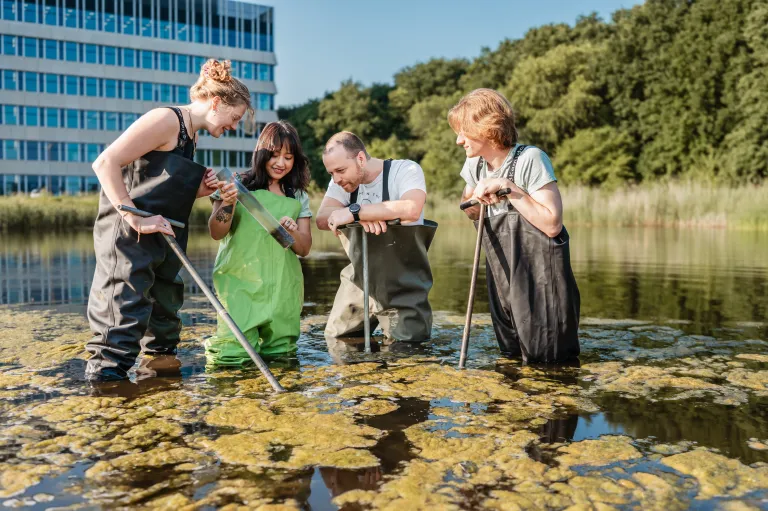
You won't just learn from books. You will have to roll up your sleeves! You'll truly understand the Earth through fieldwork, lab work, computer simulations, and data analysis.

Knowledge with impact
From the lecture hall to global impact: your knowledge is directly applicable to major issues like flooding, drought, and climate change. This allows you to make a real impact on society.

International study experience
You’ll follow this programme in English, together with students from all over the world. This makes the study experience even more diverse and it prepares you for an international career.
What you will learn
Besides learning about processes in soil, water, and the atmosphere, you'll learn to conduct various types of research. You'll go outdoors to take measurements with advanced equipment. In the lab, you'll conduct experiments and learn how to use large data sets of measurements and computer models.

You will learn
- You'll understand how soil, water, and atmospheric processes influence each other.
- You'll investigate how climate change leads to extreme weather and changes in ecosystems.
- You'll discover how rivers, deltas, and landscapes are formed.
- You'll analyze how land use and water management determine water- and soil quality.
- You'll work with field measurements, lab experiments, and data analysis to investigate global challenges.
Your courses
During your first year, you will study the core theories of Earth System Sciences, learn about processes occurring from deep underground to high in the atmosphere, and gain practical experience through fieldwork and lab sessions.
The second year is all about deepening your knowledge. You’ll explore topics such as landscape formation and water quality, the dynamics of weather, climate and the Earth system, and the the use of environmental and climate models. At the end of the year, you’ll apply what you’ve learned during field excursions.
In the third year, the choice is yours: will you broaden or deepen your knowledge? You can focus on one of the three domains (soil, water, or atmosphere), or tackle them all. Take electives from another field through a minor, or study abroad? It's all possible. You'll conclude the third year with an individual research project in one of the three main domains. Choose a graduation project that suits you and the program!
In your third year, you’ll have the freedom to choose your own minor. For example, you might select Disaster, Risk and Resilience, Geo-information for Environment & Society, or the Education minor, which allows you to qualify as a teacher after graduation.
You can also design your own minor by combining courses that match your interests. Your study adviser can help you choose an option that fits your goals. You can take your minor either in the Netherlands or abroad.
See a complete overview of all minors at WUR.
The program consists of several components:
- Lectures: you will receive explanations from a lecturer in the lecture hall.
- Tutorials: you will work on assignments with a project group.
- Practicals: you will conduct experiments in chemical labs, hydrological simulation labs, and computers labs.
- Fieldwork: you will go outside for practical assignments, either in the Netherlands or abroad.
- Self-study: this is partly included in your schedule, but you can also schedule it flexibly yourself.
At WUR, you'll receive a wealth of personalised guidance. We have more lecturers, study advisers, and supervisors than at most other universities. This reduces your risk of dropping out and helps you enjoy your studies more. You'll see that we're truly committed to your development.
At Wageningen University & Research, there are several degree programmes that cover similar themes to Earth System Sciences. However, there are also clear differences between them. We’ve listed them for you below.
- BSc Environmental Sciences
In Environmental Sciences, you’ll learn to tackle environmental and sustainability challenges. You’ll study environmental issues from natural, technological and social science perspectives. By combining these views, you learn to develop sustainable solutions to complex environmental problems. In Earth System Sciences, you’ll also work on solving environmental issues, but the focus lies purely on the natural sciences. The social science perspective is not part of this programme. - BSc International Land and Water Management
In International Land and Water Management, you’ll study land and water use, and how these can be managed responsibly. With this knowledge, you’ll work towards the sustainable and fair distribution of land and water resources in an international context. While natural science plays an important role in this programme, International Land and Water Management also focuses strongly on social and socio-economic factors. Earth System Sciences, on the other hand, takes a broader and more scientific approach, focusing mainly on the natural science aspects of these systems. - BSc Marine Sciences
In Marine Sciences, you’ll gain a deep understanding of marine ecosystems. This broad programme focuses on ecological processes in the oceans, the sea as a source of food, and its societal importance. With a degree in Earth System Sciences, you can also study and model marine systems – for example, ocean currents and the exchange of CO₂ between the sea and the atmosphere. However, Earth System Sciences does not include the social or ecological perspectives found in Marine Sciences.
Curious about how this program compares to other bachelor’s programs at other universities? Check the figures on Studiekeuze123.

Bachelor’s Open Day
6 & 7 November 2026
Experience the vibe this November and see which programme suits you best
Students about this programme
4.2/5
Student satisfaction (Studiekeuze123)12-18
Contact hours4.4/5
Atmosphere (Studiekeuze123)4.1/5
Involvement & contact (Studiekeuze123)Your life after this bachelor
Your career options are very diverse. Consider, for example, a position as:
- Climate researcher at knowledge institutes or universities (e.g., KNMI, Deltares, Wageningen University & Research).
- Water management position at water boards or Rijkswaterstaat, focusing on water quality and flood prevention.
- Environmental advisor at consultancy and engineering firms (e.g., Arcadis, Royal HaskoningDHV).
- Sustainability policy officer at ministries, provinces, or municipalities.
- Geo- or data analyst at research institutes or companies working with satellite data, models, and big data.
- NGO specialist at international organisations such as the World Wildlife Fund or UN Environment.
- Climate adaptation consultant for companies and cities preparing for the consequences of climate change.
- Project leader at nature organizations such as Natuurmonumenten or Staatsbosbeheer.
Student Career Services facilitates WUR students towards the labour market. If you need help in your orientation towards your future career.
Many students pursue a master's degree after completing their bachelor’s program. This provides you with even more knowledge and skills. These master's programs are a good fit:
If you are interested in the application of the technical aspects in societal context, you are also able to choose the MSc Development and Rural Innovation.
After completing this bachelor’s program, you can choose a master's degree from Wageningen. With the right electives in your third year, your program will be a seamless fit. Your academic adviser will work with you to ensure you can progress without delay.
Would you prefer a master's degree at a different university or even abroad? That's also possible. With a WUR bachelor’s degree, there are plenty of opportunities worldwide.
Anticipation and preparation
*Since recently, the Bachelor’s in Soil, Water, Atmosphere is now presented under the more fitting name of Earth System Sciences. When applying in Studielink, please select Earth System Sciences.
To be admitted to the bachelor’s programme Earth System Sciences, you should have studied mathematics, physics and chemistry.
Have a look at the Application & Admission page for starting at Wageningen University & Research and check whether your prior (international) education qualifies you for this bachelor’s programme.
Are you a Dutch student? Switch the language to Dutch at the top of these pages to view the admission information that applies to you.
Studying costs money. Curious about the costs involved? You can find all the information about the costs of this program on this page: tuition fees and study costs.
Wageningen offers a diverse, enjoyable, and amiable student community. Despite being a small town, you get to know people from all over the world because of Wageningen University & Research's global atmosphere. Everything in town is relatively accessible by bicycle, and the campus is contemporary and green. Whether it's a sporting event, a party, or a laid-back evening with friends at one of the student associations, there's always something going on. Additionally, there are parks, forests, and a river nearby, so if you enjoy the outdoors, you're in the right area. Discover all about student life in Wageningen.
Questions about this study?
Do you have questions about the Earth System Sciences program? You can always send a message directly to the study adviser.
Discover WUR


Discover all Bachelor's programmes at Wageningen University & Research
Follow Wageningen University & Research on social media
Stay up-to-date and follow all activities and stories of our students on our socials.