How do we share landscapes with wildlife?

- VFP (Vincent) Koperdraat
- Spokesperson / Media Relations
Sjo / iStock.com
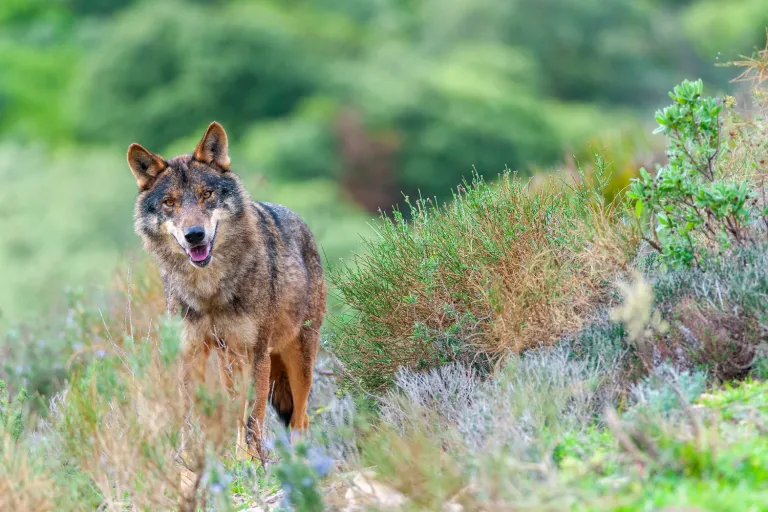
Wolves, beavers and large grazers are finding their way back to the Netherlands. The return of these wild animals, which are increasingly coming into contact with people, raises difficult dilemmas. During the Opening of the Academic Year (OAY) on 31 August, Hugh Jansman, Maarten Jacobs and Sabrina Dressel will share their perspectives on a central question: how can people and wild animals learn to coexist?
When it comes to wildlife, Hugh Jansman can barely contain his enthusiasm. ‘The Netherlands is a champion of water management. But the beaver does it much more intelligently, and for free! It is going to help us enormously with the task ahead: retaining water rather than draining it away.’
‘Ungulates are vital in preventing landscapes from becoming overgrown,’ he continues. ‘You saw that recently with the wildfires in Spain: a farmer said that bison and other grazers had eaten all the combustible vegetation. His pasture was untouched by the fire, and all his livestock survived. Wolves, in turn, play an important role in regulating that grazing. Because grazers do not feel safe everywhere, you get greater variation in grazing. This can also create opportunities for forest regeneration.’
The return of wolves, beavers and large grazers is good news for biodiversity, which is under severe pressure in the Netherlands. But when wild animals make the news, the focus is often on danger and nuisance. Beavers pose a threat to dykes, roads and railway lines; large ungulates sometimes clash with hikers in nature areas. The wolf became permanently established in the Netherlands in 2018 and has since been the subject of heated public debate ever since. These predators attack livestock and, in rare cases, people as well.
Join us at the Opening of the Academic Year 2026-2027 on Monday 31 August, from 15.00 to 17.30! This year’s edition focuses on the dilemmas associated with the return of wild animal species.
Read more and register here, or watch the livestream.
Among the wild animals
As a Senior Researcher Wildlife Ecology, Jansman knows all too well the emotions that wolves can stir up. Last year, he and his team analysed DNA traces on the bloodstained shirt of a six-year-old boy who had been bitten by a wolf. ‘I was left speechless when I received that shirt. What an attack like that must have done to that boy, and to his parents…’
Jansman has been researching the ecology of wolves and other wild animals for more than fifteen years. During that time, he has seen the debate about wolves become increasingly heated. ‘As a scientist, I do find that debate concerning. Mainly because, as a country, we are failing to make proper use of the knowledge that is available. We have been writing reports for the government since 2012, providing policy support and organising workshops with all stakeholders. In these, we present options for enabling a sustainable future and keeping conflicts with nature manageable.’
‘We have not been sufficiently successful in achieving that,’ Jansman continues. ‘It took four months to track down Bram, a wolf that had bitten people! And if another high-risk wolf appears tomorrow, the authorities once again won’t be able to respond quickly.’

Hugh Jansman
‘We recommend having a thorough contingency plan in place so that swift action can be taken. Such a protocol would also help reassure concerned visitors and residents. This can be achieved by establishing a team of experts that can properly assess a problematic situation and intervene quickly when necessary, and by ensuring that permits and tracking collars are already available. There is much to be gained from fitting potential high-risk wolves that come too close to people with tracking collars, so that they can be closely monitored and taught to avoid people. And if that doesn’t work, the wolf can be culled efficiently.’
Because no adequate action is being taken – and because social media amplify fear and anger – the perception is emerging that wolves pose an enormous threat, says Jansman. ‘A primary school in the east of the Netherlands closed because a wolf had been spotted nearby; a scouts’ weekend was cancelled because wolves were roaming the woods. We really need to find a way to deal with this. And that applies to other wild animals too. If large cattle are blocking the path in a nature reserve, especially with calves, you can’t always walk past them. Sometimes you have to wait a moment, or take a detour.’
Another recurring theme in discussions about wolves is attacks on sheep and other livestock. Jansman: ‘For an individual livestock farmer, this can be a real problem, but it is sometimes said that the wolf is “killing” the agricultural sector. It is not.’ Of the sheep that died between 2017 and 2025 before being sent to slaughter, 0.7% were killed by a wolf. Moreover, 90% of the sheep attacked by wolves had not been adequately protected with wolf-proof fencing or other protective measures.
Jansman: ‘I fully understand the emotions of farmers who wake up one morning to find that their animals have been mauled by a wolf. At the same time, I am surprised that, after ten years of wolves being present, so much vulnerable livestock is still inadequately protected. How can we, as a society, provide even better support to livestock farmers in this?’

Crocodile brain
Fear, revulsion, curiosity, joy: wild animals evoke intense feelings in people. Assistant Professor Maarten Jacobs studies the emotions people experience in relation to the natural environment, and the psychological mechanisms behind them. These emotions play an important role in the debate about wild animals, but are often underestimated.
‘How you react to wild animals is partly determined by biology. From an evolutionary perspective, our brains perceive wild animals as potential predators or prey. This is deeply ingrained. What happens when you see a lion? Your heart rate and blood pressure rise, and adrenaline is released. Your body does this to improve your chances of survival, and it all happens automatically. This response comes from a very instinctive part of the brain, sometimes referred to as the crocodile brain.’
‘But everyone processes that input from the crocodile brain differently. That, in turn, has to do with your personal experiences and the culture you grow up in. And changes can also take place in the brain. For example, people may be afraid of wolves because they had a negative experience with a dog during childhood.’
Before wolves had become established in the Netherlands, Jacobs conducted research into the emotions that people in the Netherlands, Germany and Canada feel towards wolves. In surveys, respondents were asked to indicate how intensely they experienced these emotions. The pattern was more or less the same in across these three countries: there were significant individual differences, but the most common emotion was interest. People also felt fear, but just as often they felt joy.

Maarten Jacobs
Where emotions surrounding the return of wild animals run high, polarisation increases. People who want wolves to be driven away or shot are directly opposed to those who believe that no wild animal should be killed by humans. ‘There is a caveat to that,’ says Jacobs. ‘Many people are actually somewhere in the broad middle and do not view the issue quite so sharply. But for the two extremes, the wolf is very useful. Active polarisers use the animal as a symbol of wider social discontent: farmers versus nature conservation, urban versus rural communities, ordinary people versus the elite. In doing so, they fuel polarisation.’
Jacobs believes that the debate about wild animals actually needs more compassion and less polarisation. ‘Conservationists sometimes accuse opponents of suffering from the Little Red Riding Hood syndrome: an irrational fear of the big bad wolf, fuelled by fairy tales such as Little Red Riding Hood.’
‘But the fact is that some people are afraid of wild animals, and we shouldn’t judge or ridicule them for that. There are psychological aspects to this fear, such as the crocodile brain and past experiences. There are also underlying value patterns that play a very important role. You can’t just change those overnight.’
Managing people and animals
So how can society deal with wild animals, given that they are here to stay and stir up so many emotions? That is where the concept of coexistence comes in: people and animals not just occurring in the same areas, but sustainably sharing the same landscapes.
‘Coexistence requires both people and animals to change their behaviour’, says Assistant Professor Sabrina Dressel. ‘For humans, that means adapting how we use shared landscapes. Drive more slowly in a forest at night, don’t let your dog off the leash in certain areas. Don’t feed wild animals, keep your distance, stay on the trail. That might make some people uncomfortable, as some of these adaptations restrict what we are used to doing. But coexistence is not a one-way street.’
Wild animals, on the other hand, can also adapt to human presence and management. ‘Animals are extremely adaptive. There are different ways in which we can influence where and how animals use a landscape. In some contexts this may involve physical fences, in others we can use deterrents such as sound or light signals. But what works depends very much on the species and the situation.’
Dressel is fascinated by the different ways in which people learn to share landscapes with wild animals. ‘People use many different forms of adaptation to reduce conflicts and make coexistence possible. And there is no single approach that works everywhere. For example: livestock guardian dogs are commonly used to protect against wolves, but don’t always work as intended. In some regions, having dogs simply isn’t part of the culture. And in the French Alps, they have been shown to scare or create problems with hikers and other visitors.’

Sabrina Dressel
Finding out what works can only be reached by getting everyone involved, says Dressel: ‘It’s all about having an inclusive dialogue about what coexistence means in a certain context. Because coexistence is not an end point, it has to be discussed and managed. There are ecological and legal boundaries, but within those, society continuously has to negotiate what is considered acceptable.’
Much of Dressel’s research has been focussed on Sweden, where she studies how people are managing coexistence with moose, wolves and other wildlife. Creating room for locally adapted decision-making seems to be key, in order to bring discussion closer to the people affected. ‘But there is no single way of organising these discussions: the social and ecological context can be very different from one place to another, even within the same country.’
‘The north of Sweden is vast and less densely populated, and some management zones cover enormous areas. There, you need ways to reach local hunters, land owners, and other people. Some management groups simply used WhatsApp or other digital communication to discuss how to handle issues. But in the south, areas are smaller and more densely populated. You can’t just use the same form there, so they had to come up with something different. They developed mentor systems, with members of the management group being responsible for staying in contact with particular local groups.’
Sharing spaces
Dressel concludes that governments should give people the resources and room to adapt management to local circumstances – while still providing clear safeguards for how to shape coexistence with wild animals. ‘There is rarely one blueprint that works everywhere. Don’t put up barriers to local solutions. Communities often come up with new ideas! It’s important to utilise that, not to ignore it.’
‘If we revitalise nature in the Netherlands and learn to coexist well with wild animals, we will truly reap the benefits,’ says Hugh Jansman. He draws inspiration from NL 2120, a vision developed by WUR of what the Netherlands could look like a hundred years from now. A country with climate-resilient cities, room for water and nature-based solutions, where people live alongside nature. ‘Then you would have a beautiful blue-green network with a more gradual transition between natural and cultivated land. And that means there is less risk that a wild animal venturing out of a natural area will be perceived as a conflict.’