Involve nature in protecting the coast
- Jim van Belzen
- Ecologist

“It is not primarily about adding nature: it is particularly also about protection against the water and a future for agriculture on saline land”
Rising sea levels, land subsidence and siltation are putting pressure on our delta. Ecologist Jim van Belzen examines how nature itself contributes to building landscapes and how you can use nature to make the coast safer and enhance biodiversity.
Classic ecologists look at the preconditions under which plants or animals can live in an ecosystem. Jim van Belzen looks at it in reverse: "I study how plants and animals in brackish tidal areas affect the landscape. Just as we humans influence our living environment, plants and animals also shape theirs. They have a certain tolerance to environmental conditions, such as temperature, wave action and current. But they can also make environmental conditions more stable, allowing them to live there better."
Van Belzen wants to understand how natural ecosystems such as estuaries and salt meadows can be part of climate resistant landscapes: "Think of dune plants creating dunes or salt marsh plants building salt marshes." Being from Zeeland, Van Belzen prefers to speak of salt marshes rather than salt meadows.
An estuarine ecologist for Wageningen Marine Research and NIOZ (Netherlands Institute for Sea Research), Van Belzen is working on the boundary of sea and river. "Before people lived in the Dutch coastal zone, the coastal landscape was formed by dunes with peat bogs behind them. Where the sea invaded those peatlands, mud flats and salt marshes formed. When these salt marshes grew higher due to land accretion, people built a dike around them, because it was fertile agricultural land. Since around the year 1100, a system of dykes and reclamations subsequently developed all along our coast."
Flipside of reclamation
It made the Netherlands a champion in building dykes and reclamation. "And we owe a lot to that," Van Belzen emphasises. But there is also a flipside: "Centuries of reclamation stopped the natural build-up of the coastal landscape. Outside the dykes, sea levels continue to rise, but inside the dykes the ground is becoming lower because sand and silt are no longer transported there."
History has shown that the land behind dykes is vulnerable due to subsidence. Interestingly, where there were no salt marshes in front of the dike, the damage was greatest, Van Belzen learned: "This happened in the Christmas flood of 1717, for example, but also in the 1953 flood disaster, when the dykes in Zeeland and South Holland were found to be too low in many places. Salt marshes break waves and act as a barrier when a breach occurs. So we only get wet feet instead of catastrophic flooding."
He emphasises: "The Zeeland and South Holland delta is perhaps the safest delta in the world. But the ecological price is high. Several plant and animal species have become extinct; others are in danger of extinction. That has economic consequences too: the fishing industry is suffering. For example, the oyster sector is facing major challenges to maintain productivity."
Double dyke systems
Van Belzen argues for double dyke systems: polders where you temporarily allow the tide in so that natural sedimentation raises the land. "In a variety of studies, including with HZ University of Applied Sciences, we have shown that by constructing these double dyke systems, we can keep a large part of Zeeland safe after a dyke breach. Even if sea levels rise one or two metres."
Meanwhile, dyke reinforcement is being planned in the Zak van Zuid-Beveland. "We have proposed converting a few polders near Hoedekenskerke into double dyke systems. The agency HKV has calculated that these can prevent hundreds of hectares of flood damage after a dyke breach."
Strong emotions
Should we do it? It is not that simple. "The word 'de-poldering' then quickly sets the tone, evoking strong emotions in Zeeland. And I get it. But it is not primarily about adding nature: above all it is also about protection against the water and a future for agriculture on saline land.”
Emotions ran so high that a motion was passed in the Zeeland Provincial Council banning the construction of double dyke systems. Nevertheless, Van Belzen sees movement: "A deputy from the BBB changed their mind when we showed what we wanted to do. The conversation is shifting, but it takes time."
Roggenplaat: sand replenishment
Outside the dykes, the recipe is clear: keep shallow water shallow, because then high waves cannot form. That does not work everywhere. For example, the construction of the Eastern Scheldt storm surge barrier has changed the current, resulting in less new sand being washed onto the Roggenplaat. This not only affected the many migratory birds and seals that use the tidal flat as a feeding and resting area, but also its function as a natural buffer off the coast.

As part of the Programmatic Approach to Great Waters (PAGW), the Roggenplaat was raised by sand replenishment to restore nature and wave attenuation. Worldwide, it has been one of the largest replenishments built for this purpose. After five years of monitoring, Van Belzen notes that the approach has worked: "The Roggenplaat is once again a healthy and nutrient-rich habitat for animals and water safety has increased as waves head towards the coast with less energy."
Nature-inspired design
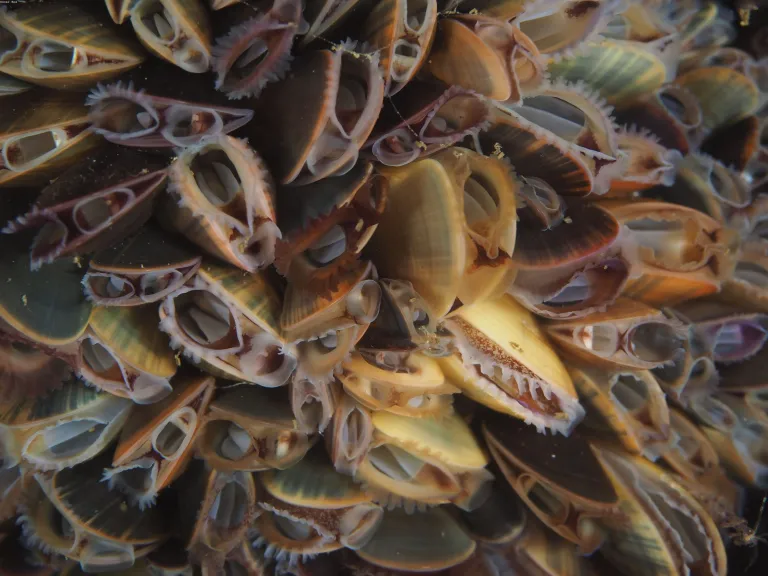
In another project, he is working on erosion-inhibiting measures, such as the construction of artificial oyster reefs in the Eastern Scheldt that slow down waves. In the basin of the Eastern Scheldt, for example, a reef is being created based on how nature itself would do it: "The computer models we designed were created with evolutionary algorithms. The initial results have exceeded my expectations: the reef not only inhibits erosion, but also retains a lot of new sand and silt and enhances nature values."
The models can also be used in other places for nature-based coastal protection: "We are talking about sea levels rising 2 to 5 metres in the future. I am not claiming that we can use natural processes to manage that rise without problems. We will probably need to lend nature a helping hand here and there. But we do need those natural processes as a robust complement to existing coastal defences."
System grows with you
Without making use of natural dynamics, coastal defence remains an expensive makeshift solution and problems are simply stored up, he argues: "Technically, we can keep raising the dykes, but it comes at a cost. Every metre higher means an extra 10 metres of soil inland. In built-up areas, you then encounter houses. Besides, you may wonder whether there are enough construction materials and people to pull off such a massive operation."

The beauty of complementary nature-based coastal protection is that the system grows with you and continues to function even when human attention has waned, as it did in 1953. In the Rising Sea Levels Knowledge Programme, a broad coalition is working on a strategy that will continue to work even with a 2-metre rise in sea levels in 2100 and 5 metres in 2200. There are conflicts of interest, he observes. "But if we only raise and close off, we are passing the buck. My hope is that we get ahead of another disaster and choose to bring dynamics back to our coastal areas. Then nature will work with us again."
Partners in this collaboration
- NIOZ
- Delta Committee
- Sweco
- Deltares
- EcoShape
- World Wildlife Fund
- NL2120
- Rijkswaterstaat
- PAGW
- Natuurmonumenten
- Province of Zeeland
Other impact stories
Wageningen University & Research (WUR) is working on major global challenges related to food, biodiversity, and climate. Our knowledge is applied by our partners. In in-depth impact stories, we share more about our research and the impact we achieve.