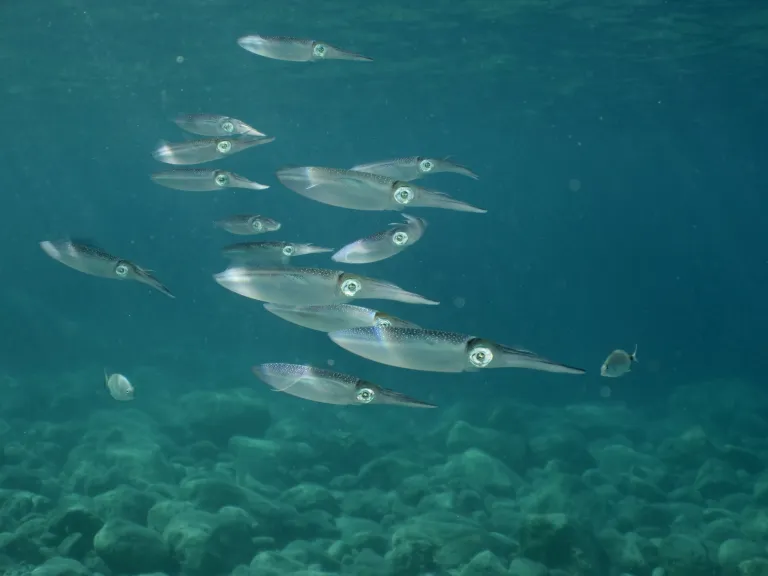
Genetic fish atlas to give management and policy a helping hand
- Jacco van Rijssel
- Researcher Wageningen Marine Research

Arthur de Bruin
“The genetic fish atlas is a good example of how fundamental research leads to genetic knowledge being translated into management and policy.”
The larger the genetic variation within a fish population, the greater the chance of survival in a rapidly changing environment. But the knowledge on this genetic variation is not yet easily available. That is why parties are joining forces to develop a so-called genetic fish atlas. The goal? To better predict the chances of survival of fresh-water fish populations and to enable focused management strategies.
Biodiversity within an area is often measured by counting the amount of species and the number of animals per species. However, this does not cover the diversity within a species. According to evolutionary ecologist Jacco van Rijssel from Wageningen Marine Research, the genetic variation within populations can teach us a lot about the resilience of the population to be able to survive in an environment that is rapidly changing. “There is an accelerating trend of ecological changes, caused primarily by human activity. Examples include climate change, the construction of weirs and locks, the introduction of invasive exotic species and the impact of fishing. The larger the genetic diversity of a fish population, the greater the likelihood that that population has the genetic traits needed to adapt.”
Van Rijssel gives the example of the European weatherfish, which prefers muddy puddles and other stagnant fresh water. “In the Netherlands, fewer and fewer populations of this species are prevalent. And many of those populations live in isolation, meaning that the DNA of the fish in each population is incredibly similar. This leads to inbreeding. Poor genes can thus be passed on more easily, and so a population can quickly die out.”
Complete genome sequence
Thanks to modern sequencing techniques, it is now possible to map out the fish genome in its entirety. Twelve years ago, when Van Rijssel was working as a postdoc in Switzerland, this still cost a fortune. Since then, the costs have decreased significantly; it is now possible to map out the entire fish genome for just a few hundred euros. And this has opened doors to new possibilities, Van Rijssel explains. “We already have an enormous amount of ecological knowledge on fish. This knowledge is shared through the Vissennetwerk [Dutch fish network], among other platforms, which brings together experts from universities, research agencies, consultancy firms and government bodies. But we still don’t know much about the genome and the specific genes that are inherited. That is how we came up with the idea for the genetic fish atlas.”
The genetic fish atlas working group (Kerngroep Genetische Visatlas) - an initiative by Wageningen University & Research, RAVON, Sportvisunie (the Dutch angling association), Radboud University and the Research Institute for Nature and Forest (Instituut voor Natuur- en Bosonderzoek, INBO) - started working on the idea. Van Rijssel: “A fish atlas actually already exists - a 300-page-long reference book containing information about where fish are prevalent in the Netherlands, how they survive and what developments they are experiencing. For the genetic variant, we are considering a practical online tool with which you can find all sorts of relevant information on a case-by-case basis by zooming in.”

Arthur de Bruin
Obstacles
The insights that the working group strives to unlock will provide points of reference for management and policy. As an example, Van Rijssel points out the obstacles in Dutch waters: “We can very easily sample fish from the same species on either side of a lock or another obstacle. On the basis of these samples, we can determine from the genome whether the fish are spawning with one another. If so, then we don’t need to construct a fish passage. But it could equally indicate that intervention is required if the population downstream doesn’t seem to have any contact with the population upstream. In that case, there would be a high risk of a population becoming isolated and displaying inbred traits.”
Van Rijssel also gives an example of how the atlas could help to quickly and cheaply test the efficacy of strategies. “We recently conducted genetic analyses of river lampreys and brook lampreys in the Veluwe. The brook lamprey is struggling there, so river lampreys were introduced to give them a helping hand. But young lampreys of both species cannot be distinguished with the naked eye. By genetically monitoring them, we can see that the populations appear to have merged. So, we can see that the strategy is working well.”
Exotic species
Modern sequencing techniques also make it possible to trace the origin of fish species. This knowledge is highly valuable, as the Netherlands has an abundance of exotic species that may disrupt the native food chain. Van Rijssel: “These exotic species arrive in the ballast water of ships or via other routes, for instance, transport by humans. In practice, this often goes unpunished, as the origin cannot be ascertained.”
With sequencing, however, the origin can be ascertained. By sharing insights on origin via the online tool, it may be possible to respond more strictly to the illegal import of exotic fish. In addition, extra measures may be considered to reduce the spread via ballast water.


Bottom-up-project
The genetic fish atlas is dependent on financial support, Van Rijssel emphasises. “This is a bottom-up project by all of the research parties together. We plan to form a consortium before the end of 2026, which can then get to work on the atlas next year. If that works out, then the first version may already be complete in 2028.”
Through this work, a bridge is being built between fundamental research and practice. “I started working at Wageningen Marine Research eight years ago, with the aim of getting to know the applied side of things. The genetic fish atlas is a good example of how fundamental research leads to genetic knowledge being translated into management and policy. When I first got into genetics, I could never have predicted that. Now we can see that this sort of research is crucial for effective strategies.”
Organisations involved
- Wageningen University & Research
- RAVON
- Sportvisunie (the Dutch angling association)
- Radboud University
- Research Institute for Nature and Forest (INBO)

Impact achieved
Genetic analyses provide new insights into the resilience and connectivity of fish populations and make it possible to assess the effectiveness of management measures. The genetic fish atlas aims to make this knowledge accessible to management and policy, enabling more targeted measures for freshwater fish populations.
Together we make a difference
Do you have a question about the genetic fish atlas or do you want to collaborate with us? Contact our expert.
Other impact stories
Wageningen University & Research (WUR) is working on major global challenges related to food, biodiversity, and climate. Our knowledge is applied by our partners. In in-depth impact stories, we share more about our research and the impact we achieve.
Taking an integrated view of human pressures on the North Sea and Wadden Sea
The European flat oyster makes a comeback in the North Sea
How seabirds respond to disturbance in the North Sea
Restoration of salt marshes and seagrass beds delivers a triple win