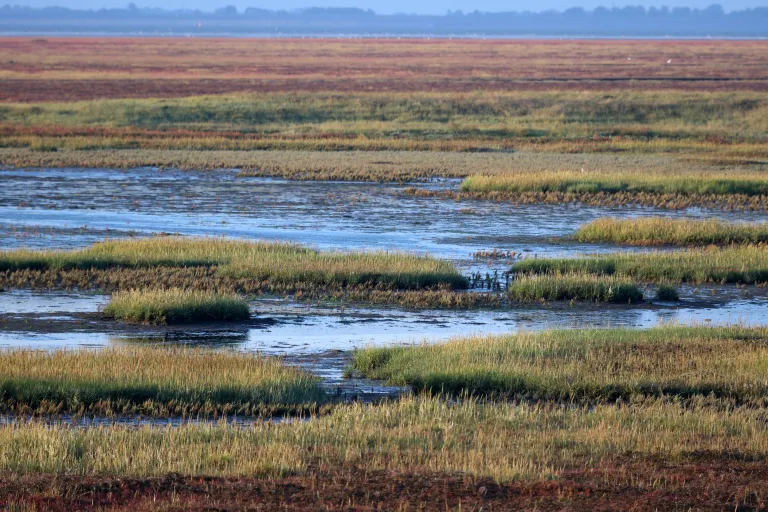
The European flat oyster makes a comeback in the North Sea
- Pauline Kamermans
- Senior Researcher in Marine Ecology and Aquaculture

Floor van Driessen
“Creating areas with a high density of European flat oysters, just like it used to be – that is our goal.”
The European flat oyster, once a magnet for plant and animal species in the North Sea, all but entirely disappeared due to disturbance on the sea floor. Since 2014, Wageningen Marine Research has been working together with partners on its reintroduction. The results offer hope for the return of more sea life.
“Reefs of European flat oysters could once be found all over the North Sea”, says Pauline Kamermans, a researcher at Wageningen Marine Research. “Back then, the sea floor comprised hard substrate in many places. But due to fishing, this surface largely disappeared, and so too the surface required for oysters.”
For years, nature organisations have been advocating for measures promoting the return of the European flat oyster to the North Sea. The Dutch government also supports this goal, especially with an eye to the services that this species can provide to the ecosystem. Kamermans: “Increased biodiversity is an important goal. Oyster shells provide an attachment point for other species and can form a reef that offers hiding places. The diversity of species in reefs is much greater than on the sandy sea floor.”

De Rijke Noordzee / The Rich North Sea
Wind farms and marine protected areas
Since 2014, Kamermans has been working on the return of the European flat oyster to the North Sea. This started with literature reviews, in which she studied whether the circumstances were suitable for reintroduction. Wageningen Marine Research, together with Deltares and other organisations, subsequently mapped out what would happen to oyster larvae if they were released in different places. “To create an oyster reef, larvae need to be able to settle in the area and not drift in all directions.”
Suitable areas were selected on the basis of these studies. Together with nature organisations and dredgers, oysters were then placed around offshore wind farms and among the Borkumse Stenen (Borkum reef grounds), an area in the North Sea to the north of the island of Schiermonnikoog. Next year, this will also take place in the Friese Front (Frisian front) area of the North Sea as part of the Rif Herstel XL project. “Wind farms and marine protected areas are logical locations because no seabed trawling is permitted there. When you reintroduce oysters, you naturally don’t want them to be caught immediately.”
Stony surface
According to Kamermans, the increasing number of wind turbines in the North Sea offers opportunities for the European flat oyster: “A turbine pile is driven into the sand, after which rocks are placed around it for protection. These stones are highly suitable for oysters, which like to attach themselves to hard surfaces. Oysters were put in cages and placed on these stones. We then pulled the cages up and counted the oysters to see how many were still alive and how large they grew.”
The insights gained have been shared in the Rich North Sea toolbox, a platform for biodiversity development in offshore wind farms. However, the method using cages does have a downside. The cages can become overgrown, resulting in oysters not being able to get enough oxygen or food. Monitoring them is also hard work, explains Kamermans. “We need a method that can be more easily scaled up. We are now working with Waardenburg Ecology on trials in which oysters are placed on stones connected with a ring of strong wire. It is easier to pull this ring to the surface.”
The results are promising. The adult oysters are surviving well and producing larvae. However, a challenge still remains. “A lot of the small oysters are being eaten by crabs and starfish. We would like to find a way to prevent this in a follow-up project.”

De Rijke Noordzee / The Rich North Sea
Scaling up
Follow-up projects are intended to bridge the gap to scaling up. Kamermans has a clear idea of what needs to be done. “We need to place an initial population in different spots. This has to happen in places with a suitable surface and where no sea-floor trawling occurs. A number of stony beds can be found off the coast of Belgium. These don’t exist in the Dutch part of the North Sea but we do have empty shells on the sandy floor in many areas. If the oysters manage to produce larvae, these larvae can then attach themselves to these sorts of places and start a new colony.”
Kamermans has hope for the future of the European flat oyster in the North Sea. “The oysters that have been reintroduced thus far have done well. In addition, unexpected finds have been promising. Divers have occasionally spotted European flat oysters on shipwrecks, even though we thought that this species had disappeared from the North Sea. This shows that a larva can grow into an adult oyster at the right place and the right time.”
Parasite
One obstacle remains on the path to new areas with a high density of oysters: a deadly parasite. It was unclear whether this disease was prevalent in the North Sea, so the European agreement was that only disease-free animals could be released. Kamermans: “The oysters were brought over from Norway and Ireland but these populations are vulnerable to the parasite. We since found out that a number of populations have become resistant to the parasite, but we weren’t allowed to release them, as they came from infected areas.”
To solve this Catch-22, Kamermans developed a method to select oysters from the diseased area that do not carry the disease themselves. They subsequently produce disease-free offspring that carry the resistant gene. The ministry of Agriculture, Fisheries, Food Security and Nature (LVVN) has determined that these oysters may now be released.
Kamermans emphasises how unique the European flat oyster is. “The creature is born male and then becomes female. To produce oysters in a hatchery that are to be released, it is crucial to be able to determine that enough females are present at any given moment. The good news is that a PhD researcher I supervise is developing a method to determine whether an oyster is male or female based on a small piece of gill tissue.”

De Rijke Noordzee / The Rich North Sea
RESO
Wageningen Marine Research is working together with many parties on the reintroduction of the European flat oyster. For example in the RESO project, which is delivering important new insights. “In this project, we are looking at whether we can simply produce larvae instead of small oysters in a hatchery. These larvae are then brought to another location, where they are released directly into a container filled with stones. After a number of weeks, the stones with oysters attached are then released into the North Sea.”
The major advantage of this method is that millions of larvae can fit into a space the size of a coffee filter. This makes the method highly cost effective. According to Kamermans, a trial in the port of Rotterdam has already proven to be successful. “The larvae settled on the stones and were then released. We are monitoring what is happening to the population and will run the trial again this year.”
Thanks to a new permit, the researchers will be able to release the larvae in places where underwater cables belonging to grid operator TenneT cross one another. “Stones have been deposited at these intersections. When parts of these intersections are colonised by oysters, new hot spots are formed.”
As a result, the definite return of the European flat oyster is one step closer. Kamermans: “Creating areas with a high density of European flat oysters, just like it used to be – that is our goal. At one point, human efforts should become obsolete and the oyster should be able to save itself.”
Partners in this collaboration
- Deltares
- Waardenburg Ecology
- The Rich North Sea
- TenneT
- The Ministry of Agriculture, Fisheries, Food Security and Nature (LVVN)
- Nature conservation organisations
- Offshore sector

Impact achieved
Since 2014, WUR has developed knowledge on suitable locations and methods for restoring European flat oysters in the North Sea. Reintroduced adult oysters survive and produce larvae. New, more scalable techniques and disease-resistant populations are bringing larger-scale restoration of oyster reefs and biodiversity closer.
Together we make the difference
Do you have a question regarding this subject or do you want to collaborate with us? Contact our expert.
Other impact stories
Wageningen University & Research (WUR) is working on major global challenges related to food, biodiversity, and climate. Our knowledge is applied by our partners. In in-depth impact stories, we share more about our research and the impact we achieve.
Zooplankton: the invisible motor of sea life
Genetic fish atlas to give management and policy a helping hand
Taking an integrated view of human pressures on the North Sea and Wadden Sea
How seabirds respond to disturbance in the North Sea