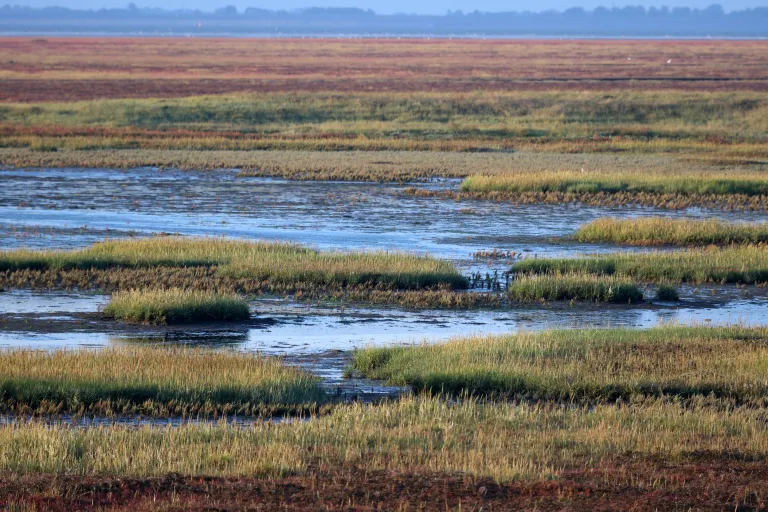
Zooplankton: the invisible motor of sea life
- Robbert Jak
- Senior researcher marine ecology

Lodewijk van Walraven
“If fish or oysters are struggling, the cause may partly lie with the plankton.”
Anyone who accidentally swallows a mouthful of water when taking a dip in the North Sea is unknowingly swallowing thousands of tiny living creatures - zooplankton. This is the collective term for all of the animal plankton in the water. Robbert Jak and Nadine Schulz are researching this invisible foundation of the marine food web. If they notice any changes, then these could indicate a shift throughout the entire ecosystem.
The term 'zooplankton' encompasses a great variety of microscopic animals, ranging from invertebrates like crustaceans and shrimp to water fleas and jellyfish. And just like shellfish, they live off phytoplankton, which senior marine ecology research associate Robbert Jak calls 'the grass of the sea'. "In turn, zooplankton is a source of food for many other animals, especially fish. And these fish are eaten by birds, marine mammals and bigger fish."
Early indicator
Just like Jak, Nadine Schulz is also researching zooplankton for Wageningen Marine Research. Her focus is primarily on taxonomy, and she explains that there are two types of zooplankton. "There's holoplankton – organisms that stay as plankton for their entire lives. And then there's meroplankton, which is only plankton for a certain stage of its life. Examples of meroplankton include larvae that sink to the seabed at one point, where they turn into other organisms such as various types of worms."
According to Jak, an organism is considered to be plankton if it cannot actively swim from one place to another. Jellyfish are also included in this category. Zooplankton are carried by the current but can also move themselves. Some types can jump or swim, and many types move vertically every day. Jak: "They sink to the depths during the day to prevent being eaten. And at night, they rise to the surface, where most of their food is located."
Because zooplankton are highly sensitive to climate change and other human-induced pressure factors, changes in this group are seen as an early indicator that something else is going on. By mapping out the plankton community, it is thus possible to create an overview of the health of the entire ecosystem. Until just a few years ago, there was little interest in this topic, explains Jak. "I did my PhD on the effects of toxic substances on zooplankton, but for a long time, we've done hardly any research on zooplankton, as there was no policy-related push for this. That all changed around 2019."

Changes in the plankton community are an early indicator that something is going on.
Long-term monitoring
Nowadays, zooplankton has its very own unit within MONS (Monitoring, Onderzoek, Natuurbescherming en Soortbescherming), a programme stemming from the North Sea Agreement and commissioned by Rijkswaterstaat (the Dutch Directorate-General for Public Works and Water Management). The goal is to create a long-term monitoring system so that data can be recorded over the years. "We want coverage not only in terms of time, but also in terms of space," explains Jak. "We also want to find out which types of zooplankton are located in which areas of the North Sea, and how many of which type can be found."
Until recently, monitoring was mainly conducted using the Continuous Plankton Recorder, a torpedo-shaped device that is dragged behind ships at a depth of around 10 metres. Plankton is caught in the device between layers of mesh and then rolled up like a film reel and stored. Upon its return to land, the mesh is cut into pieces and examined under a microscope. Since 2023, however, the Wageningen Marine Research team has also been using the Plankton Imager on board a research ship. This device is placed at a depth of five metres, where it continuously sucks in 34 litres of water per minute. Tens of thousands of photos are then taken every minute. Together, these photos form a sequence of images in space and time. With the help of an AI tool, the types and amount of species captured are mapped out.
DNA analysis
Schulz, an experienced taxonomist herself, emphasises that the computer still needs to learn a lot. "Because the Plankton Imager only captures 2D images, a lot of species look exactly alike. As a taxonomist, however, I can immediately tell which species it is from, for example, the body shape, the pigmentation or the number of hairs the creature has on its legs. The challenge lies mainly with rare species. By validating the images ourselves, we’re improving the AI model step by step."
Another type of technology is used alongside the Plankton Imager: DNA metabarcoding. This involves lowering a net to the seabed and then hauling it back up. This provides a vertical profile of the entire water column; something that the Plankton Imager cannot do. From the same sample collected in the net, the researchers take a sub-sample for microscopy and another sub-sample for DNA analysis. "The DNA analysis is very useful for differentiating the species. And microscopy provides quantitative data."
"This combination has already led to interesting results," explains Jak. "We have found new plankton species that we had never before seen in the North Sea or Wadden Sea. This is a sort of early warning, because the larvae of bottom-feeders often swim around in the plankton in large numbers before settling down. For example, in the Wadden Sea, we found larvae of the giant shell-dwelling tube worm amongst the zooplankton, although this species had previously only been recorded in Brittany. Subsequent seabed research revealed that this area was indeed teeming with worms."
Asian moon jellyfish in Zeeland
Jak has observed that the share of bottom-feeding larvae has gradually increased over the past 20 years. This has happened at the expense of classic species that spend their entire lives as plankton in the water. "We can probably attribute this to climate change, with these larvae being better able to cope with higher water temperatures."
As zooplankton react strongly to temperature changes, as well as to changes in salinity and the availability of food, can they be considered a sort of canary in a coalmine? "That is very likely," affirms Jak. He mentions a surprising discovery in a recent sample from the Zeeland Delta. "We found moon jellyfish well into the summer, although native moon jellyfish are mainly prevalent in spring. The DNA analysis proved that this was an invasive Asian species. Once established here, this species can apparently spread rapidly as it was found in various bodies of water in the Delta."

The invasive Asian moon jellyfish was found in the Zeeland Delta and identified with DNA analysis.
The new research methods that Jak and Schulz have been applying in the Netherlands make it easier to link changes in pressure factors to changes in zooplankton. "And they may also explain other developments," adds Jak. "If fish or oysters are struggling, the cause may partly lie with the plankton. This can help policymakers to take measures."
New indicators backed by new research methods - according to the OSPAR Commission, which coordinates research and environmental policy in the north-eastern part of the Atlantic Ocean, including the North Sea, that is exactly what is needed. Schulz: "Zooplankton don’t respect national borders. I think it's wonderful that we are developing training sets and establishing joint research procedures together with colleagues from Germany, Belgium and the UK. In this way, we can all work in the same manner and rely on each other’s data."
Keep monitoring
For Jak, who has researched zooplankton for decades, the increasing attention for this species is an important turning point. He hopes for further expansion. "In the Netherlands in particular, we still have lots of bodies of water where little research has been done on zooplankton. The pilot in the Zeeland Delta revealed how different the systems there are when compared to areas in the North Sea and Wadden Sea."
Schulz, who belongs to the handful of taxonomists that can recognise zooplankton, hopes for continuity. "I find it incredibly important that we continue monitoring this. You can only identify developments by conducting research over the course of multiple years; it isn't possible after just one season of trial testing." She mentions the studies on the German island of Heligoland, where 400 species of plankton have been followed since the 1960s. But her personal desire is to conduct more research in the Dutch Caribbean. "If you want to protect the coral and fish there, you also need to find out how the zooplankton is doing."
It’s a great job to have, both researchers conclude. Jak: "I'm essentially still just that same little boy fishing around in the water with a net." Schulz: "Someone else might see murky water when taking a dip in the sea. But if you look through a microscope, you will see the most beautiful organisms. It's like diving into another world. And thankfully, this is starting to grab people's attention."

Impact achieved
Zooplankton forms an important foundation of the marine food web and reacts strongly to changes in temperature, salinity and food availability. Wageningen Marine Research uses long-term monitoring, the Plankton Imager, microscopy and DNA metabarcoding to map changes in the plankton community. In this way, zooplankton can provide an early indication of changes in the ecosystem and generate knowledge for policy and management.
Together we make the difference - contact us
Other impact stories
Wageningen University & Research (WUR) is working on major global challenges related to food, biodiversity, and climate. Our knowledge is applied by our partners. In in-depth impact stories, we share more about our research and the impact we achieve.
Top athletes under pressure: seals in the Wadden Sea and North Sea
What drives sharks and rays?
How seabirds respond to disturbance in the North Sea
Taking an integrated view of human pressures on the North Sea and Wadden Sea