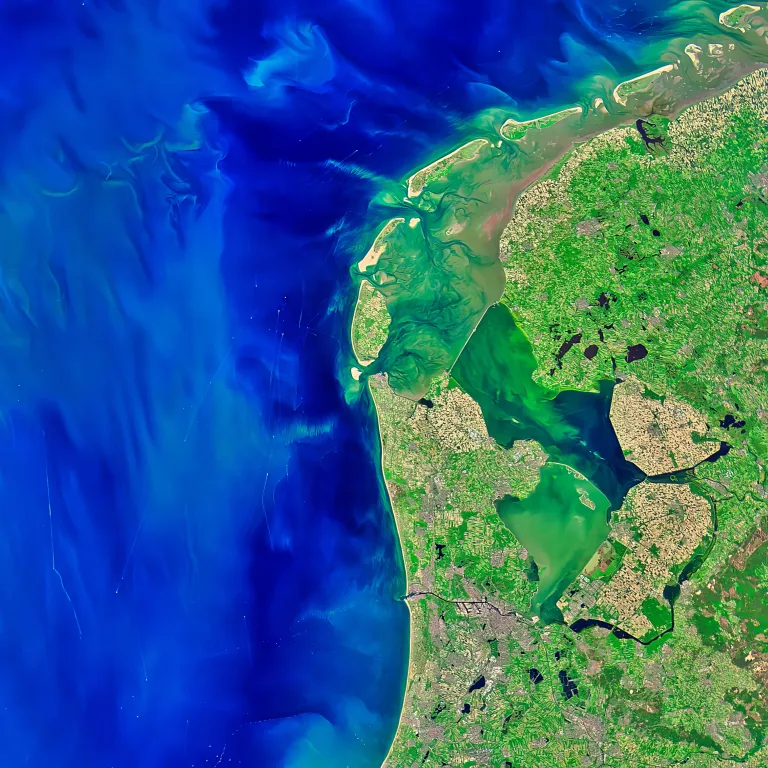
Top athletes under pressure: seals in the Wadden Sea and North Sea
- Geert Aarts
- Researcher Marine mammals

Geert Aarts
“Seals need to work incredibly hard to find food.”
At first glance, they might appear to be sunbathing: groups of groups of harbour seals on the sandbanks of the Wadden Sea. However, Geert Aarts has been studying these predators for more than 25 years and has a more nuanced view: ‘These sandbanks are their bedrooms, and they really need their sleep.’
While seals rest in the Wadden Sea, they mainly forage in the North Sea. Aarts and his colleagues are conducting research to understand which areas in the Wadden Sea and the North Sea are key hotspots for seals and what makes these locations at sea suitable for them. The knowledge acquired is used by policy makers to calculate the expected impact of wind farm construction in the North Sea, for example. To find out exactly where the seals go, the animals are fitted with GPS transmitters. In addition, counts are carried out several times a year at known resting sites. On the basis of both datasets, habitat models are drawn up to show where the seals are found in the Wadden Sea and the North Sea.

Playback Images
Life as elite athletes
The transmitters do not only show where the animals go, but they also accurately measure how they dive. The latest transmitters even have an accelerometer, similar to the one found on a sports watch. In particular, the detailed measurements thus obtained confirm that seals live like elite athletes. Aarts: ‘Seals need to work incredibly hard to find food. Sometimes they head out into the North Sea only for a day, but they may spend a week or even two weeks foraging there. And while they’re at sea, they’re diving almost constantly, day and night.’
During the most recent major virus outbreak in 2002, it is estimated that the population of harbour seals in the Wadden Sea and the North Sea declined by 50 to 60 percent. In the years that followed, there was a strong increase, which levelled off around 2013. In recent years, the population has started to fall again. Furthermore, according to Aarts the animals seem to be travelling much longer distances in search of food than they used to: ‘They probably have to travel further and further to find food.’
Geert Aarts
Research into causes
Research will determine why that is the case. One explanation might be that there has been a change with regard to food sources near the Wadden Sea. Until recently, for example, there was little fishing for lesser sand eel in Dutch waters. Danish fishermen used to fish extensively in British waters for this oily fish, which is a staple of the seal’s diet. Since Brexit and the resulting restrictions, however, it appears that more of this fish is being caught in the Dutch part of the North Sea. Aarts feels that this may have an impact.
Climate change may also play a role. Seals generally thrive in cold regions. Despite using a great deal of energy to maintain their body temperature in the cold, Aarts says that their warm-bloodedness also gives them an advantage over cold-blooded fish: ‘At low temperatures, fish have a lower swimming speed. But as the water heats up due to climate change, seals may find it increasingly difficult to catch their fish.’
Diving differently through pile driving
He also points out that disturbances at sea can affect where seals go to hunt and how successful they are there: ‘We studied the impact of pile-driving work during the construction of wind farms in the North Sea. Based on transmitter data, we observed that seals began to adapt their behaviour, in some cases even when the pile-driving was taking place 50 kilometres away.’
The data showed that the animals began to dive differently: ‘Normally, their dive follows a U-shape: they dive to the bottom, stay there for a while and then swim back up again. We noticed that this pattern changed and that the seals adjusted their movements. Interestingly, they didn’t always swim away from the pile-driving work, perhaps because they don’t know exactly where the sound is coming from. That sound travels over dozens of kilometres.’
Once the pile-driving has stopped and the wind turbines have been commissioned, some seals continue to avoid the wind farms. Researchers deduced from the transmitter data that other seals actually seem to seek out the hard ground near the piles: ‘We don’t know exactly why that is. Some animals return while others stay away, possibly because wind turbines also make a noise when they are operating. Perhaps it’s like people: some like going to the disco, while others find it too loud.’
Ecologically valuable areas
One of the most surprising findings to emerge from studies involving tagged seals over the past 25 years is that seals lead us to ecologically valuable areas that have never been discovered by other researchers. ‘To the north of Vlieland, there is an area of coarse sediment, which is rare in the North Sea. Seals hunt intensively there, probably for sand eels. The area has no name, nor does it appear on maps. ‘We know that Danish fishermen also go there to fish for sand eels, but we don’t know exactly how much fishing takes place.’
The area does not fall within any of the ‘blocks’ on the map of protected nature areas in the North Sea. And, according to Aarts, it is not the only gem that lies outside the scope of policy makers: ‘I realise that designating blocks is practical, but it might be useful to also take into account any special areas that fall outside those boundaries.’
Implement more targeted policies
The more Aarts learns about seals, the more impressive their lives turn out to be, he believes: ‘Catching five kilos of fish every day in difficult conditions - that must be quite a challenge for them. Once hunting stopped, both species thrived and experienced exponential growth. Now that the harbour seal population is in decline, the question is whether the tide might turn.’
He therefore advocates integrating scientific knowledge in order to implement more targeted policies: ‘We do our own research into seals, while others are carrying out surveys of the seals’ prey fish, but this knowledge has not yet been sufficiently brought together. If we improve in that respect, we will also be able to better understand how to maintain the balance in the North Sea and the Wadden Sea.’

Impact achieved
Research using GPS transmitters, counts and habitat models provides insights into where seals rest and forage and how they respond to changes and disturbance in the Wadden Sea and North Sea. Tagged seals have also revealed ecologically valuable areas that lie outside protected nature areas. This knowledge is used to assess the effects of human activities and can contribute to more targeted policies.
Together we make a difference
Do you have any questions or can you see any opportunities for collaboration? Please get in touch with our expert.
Other impact stories
Wageningen University & Research (WUR) is working on major global challenges related to food, biodiversity, and climate. Our knowledge is applied by our partners. In in-depth impact stories, we share more about our research and the impact we achieve.
How seabirds respond to disturbance in the North Sea
What drives sharks and rays?
The European flat oyster makes a comeback in the North Sea
Genetic fish atlas to give management and policy a helping hand