Your research, free & open to all on Open Research Europe

WUR researchers can now rapidly publish free of charge with post-publication peer review through Open Research Europe (ORE), the open access publishing platform established by the European Commission. This comes regardless of whether a national or European grant supports your research. Learn more about ORE’s approach and discover why this is an exciting opportunity for WUR researchers in our interview with WUR Professor Mangala Srinivas, a member of ORE’s Scientific Advisory Board.
Publish, Review, Curate
The publishing platform ORE allows you to publish your scientific article online first, followed by peer review by experts. The platform uses the Publish, Review, Curate model. Articles undergo rigorous prechecks before being typeset and published with a DOI. This enables immediate viewing and citation. Submissions are then sent for expert, open peer review. Review reports are made public, providing transparency, constructive scientific discussion, and recognition for the contribution made by reviewers.
ORE accepts a wide range of research outputs across scientific disciplines, including research and method articles, study protocols, data notes, replication studies, negative findings and confirmatory results. This makes it possible to publish throughout the entire lifecycle of a research project, making the research process more transparent and visible.
ORE is hosted and managed by CERN (the European Organisation for Nuclear Research). The platform was previously funded entirely by the European Commission and focused solely on EU-funded researchers. Since March 2026, national research funders and organisations such as the NWO for the Netherlands jointly provide the funding and set the strategic direction. As a result, ORE is developing into a European publication platform for the wider research community.
“We have an opportunity to rethink how we share scientific knowledge. ORE offers an open and transparent alternative to traditional commercial journals”
- Mangala Srinivas
- Professor of Cell Biology & Immunology
In a nutshell
ORE offers:
- Rapid publication with open post-publication peer review
- Immediate open access
- Transparent editorial services and peer review
- Room for different types of research output
- Indexing in scholarly databases such as PubMed and Scopus
- No publication fees for authors
WUR Professor Mangala Srinivas on ORE's Scientific Advisory Board
Mangala Srinivas, Professor of Cell Biology and Immunology, has been a member of ORE's Scientific Advisory Board since its inception, where she advocates for a more open and transparent scientific publishing system. We spoke with her about what ORE could mean for researchers and the future of scientific publishing.
“ORE offers a real opportunity to change the way we publish research. With open access, transparent peer review, and no fees for authors or readers, it provides a practical alternative to traditional commercial journals. It’s an important step towards a more open and accessible publishing culture, where we are less dependent on commercial publishers.”
Srinivas plays an active role in shaping ORE’s scientific direction, advising on editorial policies, peer review, research integrity and long-term priorities. During her first term, she advocated the indexing of ORE articles in major scholarly databases, including PubMed, Scopus and Google Scholar. Now, her attention has shifted to a bigger challenge: changing researchers’ attitudes towards where they publish.
“The next step is a cultural shift within the scientific community,” she explains. “Would researchers feel comfortable publishing their work in ORE rather than in a prestigious, top-tier journal? That is the mindset we need to change.”
With the European Commission and national research funders, including NWO, backing and financing ORE, Srinivas sees a chance to challenge established publishing practices.
“We have an opportunity to rethink how we share scientific knowledge. ORE offers an open and transparent alternative to traditional commercial journals. But for it to succeed, researchers need to embrace it as a credible and attractive place to publish their work.”
For Srinivas, ORE aligns closely with WUR’s mission to make scientific knowledge accessible and useful to society. Research on food, health, the environment and sustainability addresses some of the world’s most pressing challenges, and its findings should reach far beyond academia.
“We want our research to reach the people who can actually use it, including those outside universities who often don't have access to expensive journal subscriptions.”
Another important advantage is the opportunity to share valuable research outputs that traditional journals often overlook, such as research methods, datasets and negative results.
“Negative results are often difficult to publish in traditional journals, even though they can be just as valuable for advancing science.”
Srinivas also appreciates ORE’s transparent peer review process, which makes reviewers’ assessments and authors’ responses publicly available. She encourages WUR researchers to get involved as peer reviewers. While recognising the already heavy demands on researchers’ time, she believes that contributing to the platform is a practical way to help bring about change.
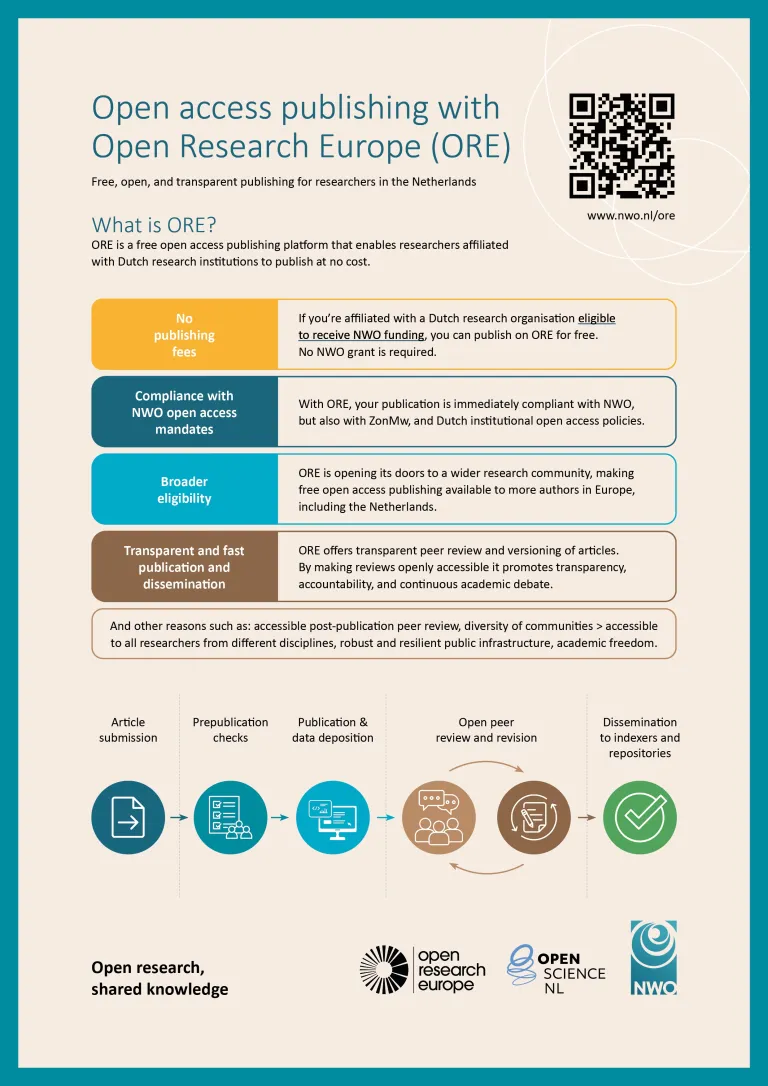
Publish, Review, Curate: How ORE works
How does Open Research Europe (ORE) ensure transparency and quality in scientific publishing? The Publish, Review, Curate model offers a different approach to traditional academic publishing.
Check out the infographic to discover how the model works in practice.
““If you’re frustrated by the limitations of the current publishing system, submitting your research to ORE or contributing as a reviewer is a way to actively support a different publishing culture.””
- Mangala Srinivas
- Professor of Cell Biology & Immunology
Find out more
WUR Library’s open access team can help you with publishing on ORE. For any questions, please email us. You can also join its launch webinar on 1 December 2026, visit the NWO website or go directly to the Open Research Europe website.
Follow WUR Library on social media
Stay up-to-date and learn more through our social channels.